
Essay - Issue 06
Curb Cut Effect
What can look like an edge case is often a concentrated expression of a universal problem.
Short Story
Most people look at DisabilityTech and see a niche. We see one of the largest overlooked markets in the world, with enough scale to build very large companies on its own. Around 2 billion people globally live with significant disability, and in the United States about 1 in 4 adults has a disability, before even accounting for the way aging expands the need for assistive and accessible products over time.
The size of the disability market is only the beginning. The more interesting story is that products built for people with disabilities often reveal something true about everyone else: when you solve a problem under real constraint, you often end up solving a broader human problem in a better way. That is why curb cuts, closed captioning, the electric toothbrush, audiobooks, and other accessibility-driven innovations so often move from adaptation to everyday use.
This is one of the core reasons DisabilityTech is so exciting from an investment perspective. These companies are not just serving an important market; they are often building at the edge of human need, where urgency is high, user insight is unusually clear, and the best solutions have a habit of spreading into much larger markets. Below is the longer version, intended both as an explanation of a core part of the Adaptation Ventures' thesis and as a reference for founders building in the space.
Long Story
What the curb cut effect is
The curb cut effect starts with something simple and physical. Sidewalk curb cuts were pushed forward by disability rights advocates so wheelchair users could move independently through cities, but the resulting design change ended up helping many more people, including parents with strollers, travelers with rolling luggage, and workers moving carts or packages.
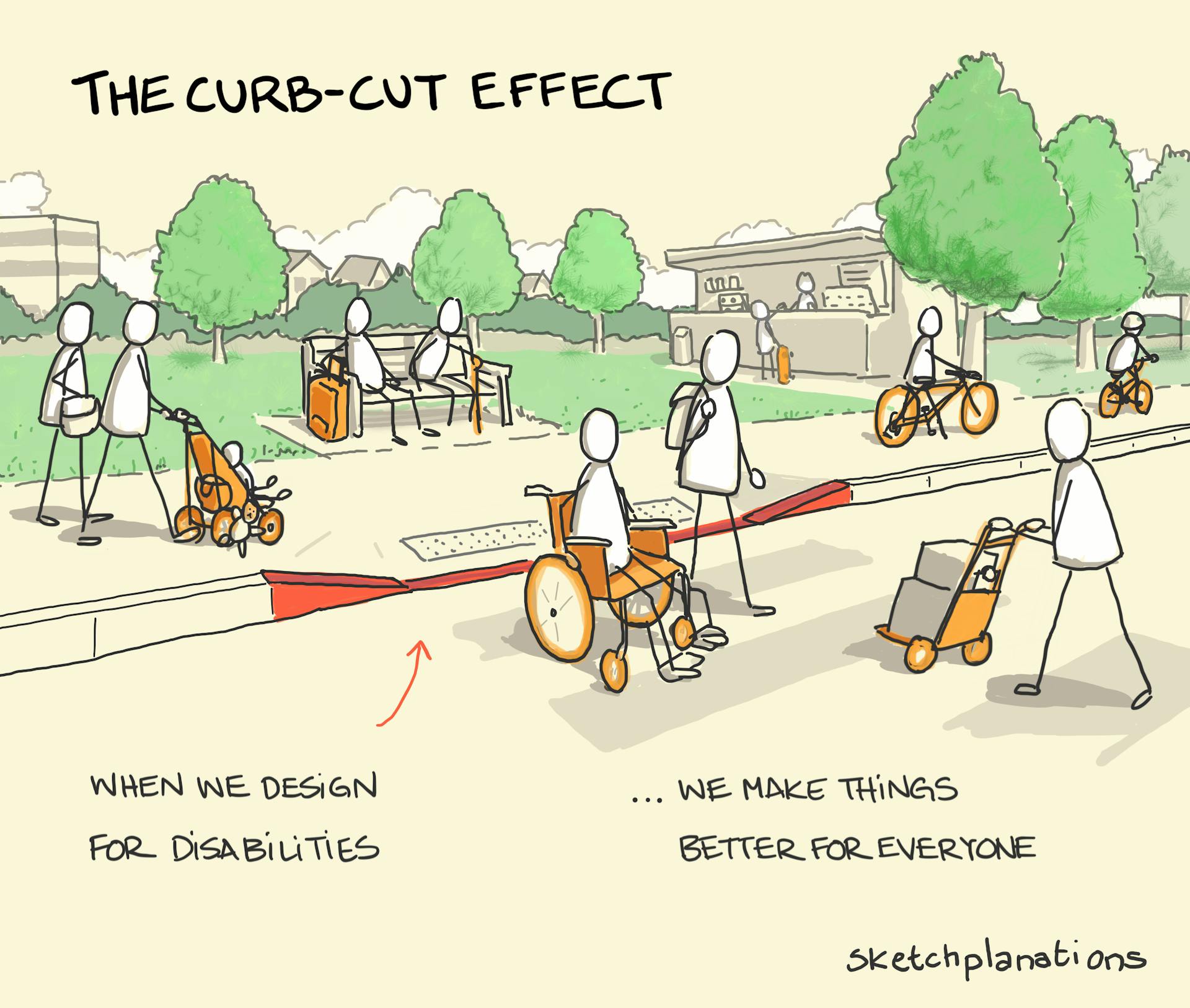
Over time, "curb cut effect" came to mean something larger: when a product, policy, or design decision is created to serve people at the margins, the benefits often spread to the mainstream. That principle matters far beyond urban design. It helps explain why technologies built for people with disabilities can become widely used consumer tools, enterprise products, and major businesses.
In investing terms, this changes the way a market should be evaluated. What can look like an edge case is often a concentrated expression of a universal problem. The company serving that edge case is not always building for a small market; it may be discovering the most important version of the problem first.
The disability market is already large enough
Even without any spillover into broader markets, disability is already large enough to support venture-scale outcomes. As mentioned above, the World Health Organization estimates that around 2 billion people, or 16 percent of the global population, live with significant disability, and the CDC says that about 1 in 4 U.S. adults has a disability.
This market is also growing in practical importance as the population ages. The United Nations says the number and share of older persons in the global population will continue to rise for decades, which matters because disability and age often intersect in ways that increase demand for better mobility, care coordination, communication, and daily living support.
And this is not a low-spending market. Return on Disability Group's 2024 research estimates that people with disabilities and their households represent more than $18 trillion in annual spending power globally. That alone should be enough to move disability out of the category of "important but small" and into the category of "commercially serious."
Why disability-first companies can become much bigger than they look
Disability-first companies often begin with a user who has intense need, clear pain points, and a strong reason to adopt a better solution. That is an unusually good starting point for building product. It creates tighter feedback loops, sharper product insight, and in many cases a more defensible wedge than starting with a broad market where the need is real but the urgency is lower.
Just as importantly, companies serving high-need populations have time to hone their craft. They can get extremely good at solving a hard problem for users who care deeply, which means that when they move into broader markets, they are often more prepared than a company that tried to work backward from a mainstream audience from day one. They are not guessing at what matters most; they have already learned it under pressure to deliver something truly useful.
That is what makes the curb cut effect so interesting from an investor's perspective. The first market is real, but the larger opportunity comes from the fact that the truths discovered there often apply much more broadly: people want communication to be clearer, care to be easier to navigate, learning to be more flexible, work to demand less friction, and mobility to improve over time.
Classic examples and new company archetypes
The curb cut effect becomes much easier to understand once you stop treating it like a theory and start looking at products people already use every day. Closed captioning was built to make video accessible to Deaf and hard-of-hearing audiences, but it is now used broadly by hearing users watching in noisy environments, on silent autoplay, or while learning a language. Electric toothbrushes are another useful example: they are widely cited as having been developed in part to help people with limited motor control, and then became a mainstream consumer category because they turned out to be convenient, effective, and easy for everyone to use.
That same pattern shows up again and again in DisabilityTech. A company starts with a user whose need is intense, specific, and easy to underestimate from the outside. In solving that problem well, the company often uncovers a broader truth about how people communicate, learn, move, organize, or navigate the world – and that broader truth can support a much larger business than traditional investors first assume.
CES 2026 award winner HapWare is a good example of this pattern. On its website, HapWare says it is building ALEYE, a device that translates nonverbal social cues such as smiles, nods, gestures, and body language into distinct haptic patterns for people who are blind, low-vision, or neurodivergent. That is clearly a massive disability-first use case, but those needs translate – pun intended – to the mainstream, where cross-cultural communication, defense, and robotic intelligence all rely on nonverbal social communication and a better understanding of human intent.
The same logic applies to several other company archetypes worth paying attention to:
- Care navigation platforms can start by helping people with disabilities and families coordinate specialists, therapies, benefits, equipment, and records – then they can expand into broader healthcare navigation because everyone wants care to be more coordinated and easier to understand.
- Executive function tools can begin with ADHD and neurodivergent users who need help with planning, prioritization, and follow-through – then they can move into mainstream productivity because almost every knowledge worker wants to be more organized and more effective.
- Exoskeletons and mobility augmentation can begin in disability and rehab – then they can move into eldercare, workplace safety, logistics, and physical performance. Ekso Bionics is a useful example because the company markets robotic systems for rehabilitation as well as exoskeleton products designed to reduce injury and strain in industrial settings.
- Accessible communication interfaces can begin with AAC, or augmentative and alternative communication, which refers to tools and methods that support or replace speech for people with complex communication needs, and from there, the opportunity can expand into education, customer support, workplace collaboration, translation, and robotics because clearer expression and understanding matter everywhere.
- Sensory-friendly software and adaptive user experiences can begin with autistic users, people with migraines, or people dealing with fatigue and cognitive overload – then they can improve software more broadly because lower-friction experiences tend to benefit almost everyone.
- Financial tools can begin with the realities of disability-related savings, eligibility, and benefits planning. ABLE accounts themselves show how specific and important these needs are: tax-advantaged savings accounts that allow eligible people with disabilities to save for qualified disability expenses without losing access to certain means-tested benefits. That same complexity points toward broader opportunities in guided finance, family coordination, and tools for households dealing with constrained decisions and administrative complexity.
- Remote monitoring and independent-living tools can begin with disability and aging-in-place use cases – then they can spread into mainstream home safety, family caregiving, and consumer wellness as populations age.
- Education tools can begin with students who need flexible formats for learning, pacing support, or alternative ways to access information – then they can grow into much larger education and workforce training markets because better learning design tends to help more people than the original target user.
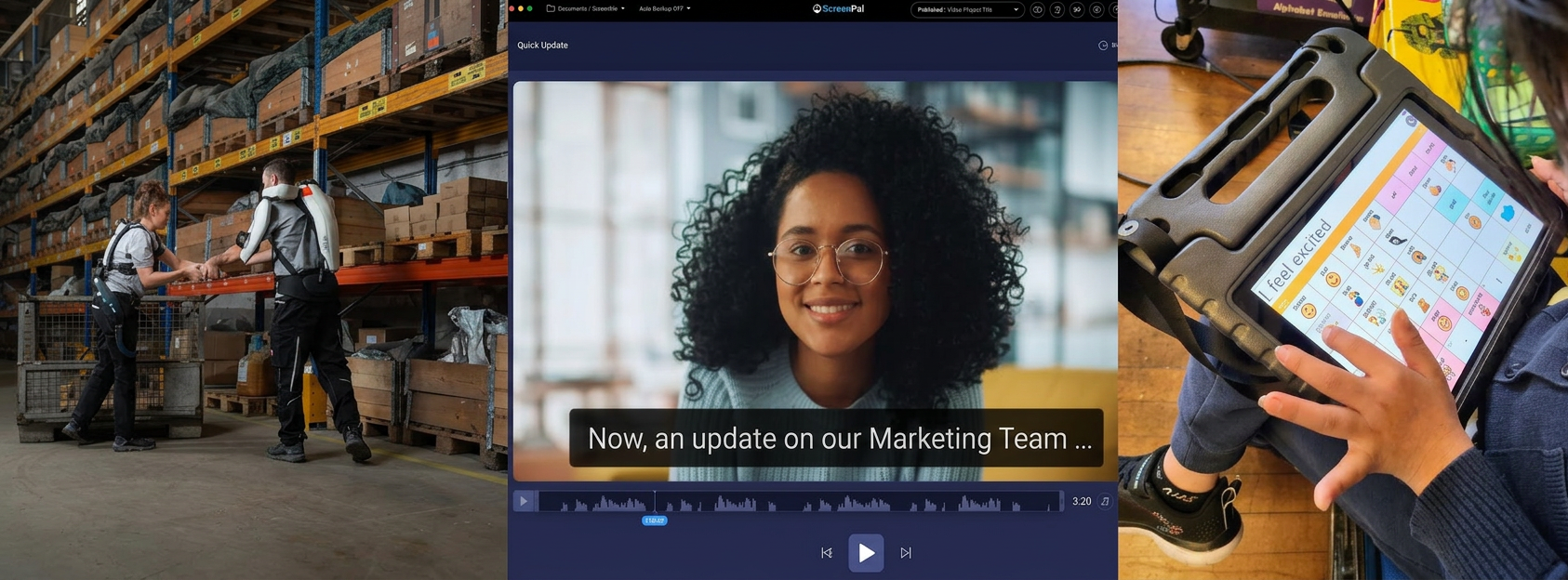
This is the part of the disability market that many investors still miss. They see an initial wedge and assume the company is capped by that wedge. In practice, the wedge is often where the product becomes good enough, sharp enough, and important enough to earn the right to move outward.
If you are building in one of these areas – or in another disability-first category that reveals a broader human need – reach out here and let us know about your work.
Clear path to exit and impact
The strongest outcomes in this space do not come from saying, "we built something admirable for a niche." They come from building something essential for a high-need population, proving that users adopt it, and then showing that the core insight applies to adjacent markets as well.
That path matters because companies serving people with disabilities often get stronger before they get broader. They spend their early years learning from users with urgent needs, higher stakes, and less patience for weak products. By the time they move outward, they are often better prepared to act on the deeper truths they uncovered than a company that started by trying to appeal to everyone at once.
Mobility is a helpful example. Robotic and augmentation products for rehabilitation use cases including stroke, brain injury, spinal cord injury, and multiple sclerosis, are also applicable to industrial exoskeletons aimed at reducing injuries and improving performance in work environments. Whatever the exact outcome for any one company, the broader lesson is clear: if a product helps people move better in one of the hardest contexts, there is a reasonable chance it can create compounding value in many others.
Communication is another. AAC began as a category focused on helping people with complex communication needs express themselves more clearly. But the underlying lessons – how to translate intent, preserve context, and make communication easier across constraints – have obvious relevance in education, customer service, collaboration software, and human-machine interaction.
Financial products are similar. The rules around disability benefits, eligibility, and savings are so complicated that they force a product builder to understand real-world tradeoffs, household decision-making, and administrative friction at a very high level. A company that learns to navigate that complexity well may be far better prepared to build broader financial products for families dealing with uncertainty, caregiving responsibilities, or complicated benefit systems.
That is why the opportunity here is not only an exit, though exits matter. It is also impactful in the truest venture sense: building companies that start by making life more workable for people with disabilities and then carrying those lessons into much larger markets. The best disability-first companies do not become interesting despite their starting point. Very often, they become interesting because of it.
Why this fits our thesis
This is one of the reasons Adaptation Ventures focuses on disability tech, neurodivergence, and accessibility innovation. The fund's approach is rooted in the belief that disability is not only an area of unmet need, but also a source of insight, invention, and company creation that many investors still underestimate.
The curb cut effect is a core part of that thesis. We are interested in companies that begin with a clear disability-first wedge, solve something truly important for the people they serve, and have a believable path toward a larger adjacent market because the problem they are addressing turns out not to be small at all. In many cases, it is simply most visible at the edge first.
This matters to LPs because it creates a different kind of early-stage opportunity set. These businesses are not always trying to win by copying an existing mainstream category with slightly better execution. Often, they are uncovering demand that is more intense, more durable, and more revealing than what shows up in a broad-market survey or trend deck.
It matters for founders too. If you are building for people with disabilities, you should not feel pressure to apologize for the specificity of the problem you are solving or recoil when a prospective investor calls you "niche". Very often, specificity is where real insight begins. And in the strongest cases, that specificity is exactly what makes the company much bigger than it first appears.
Thank you for being part of the Adaptation Ventures journey.
This journal is for informational purposes only, is not a prospectus, may not be relied on as legal, tax, securities or investment advice and does not constitute an offer to buy or sell interests in Adaptation Ventures Fund I (the "Fund").