Essay - Issue 08
Ethereal vs. Material
When software gets easy, hardware gets interesting
A lot has changed since Paul Graham of Y Combinator wrote:
Maybe the advantage of software will turn out to have been temporary. Hackers love to build hardware, and customers love to buy it. So if the ease of shipping hardware even approached the ease of shipping software, we'd see a lot more hardware startups.
That was 2012, and in comedically ironic form, none other than Sam Altman of OpenAI fame read a draft of that letter.
Fast forward to today.
Short Story
For a long time, hardware was where venture enthusiasm went to get humbled. It was slow and expensive. It required tooling, supply chains, inventory, certifications, returns, firmware, and patience. Software could ship on a Friday night. Hardware could get stuck on a boat, fail a drop test, or die in the gap between prototype and production.
Something has changed.
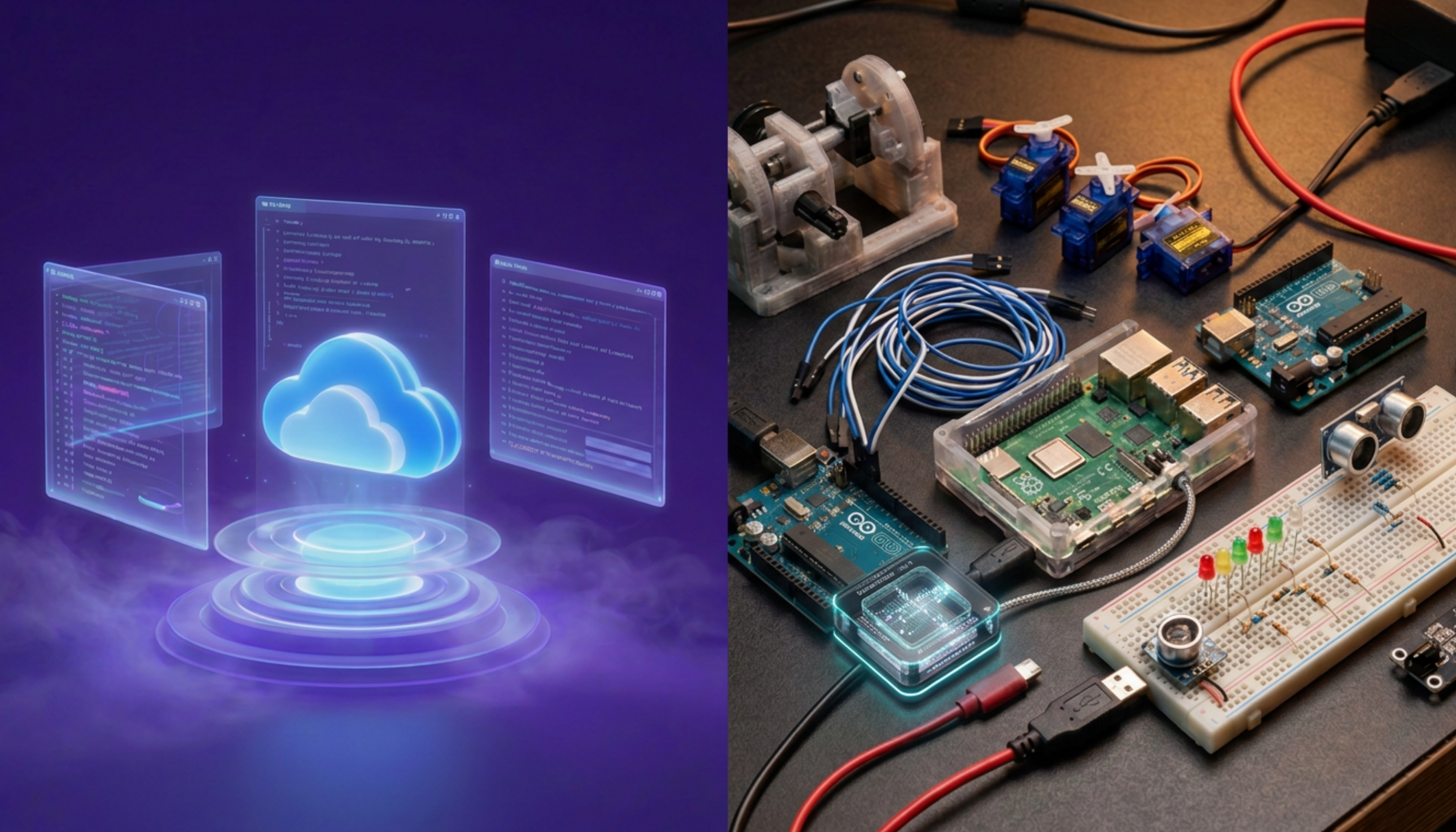
The ecosystem around hardware is starting to look more like the ecosystem around software. Prototyping is faster, components are better, and AI is now part of design, simulation, sensing, and edge intelligence. Additive manufacturing has moved into the mainstream of product development, and organizations that help physical-product startups cross the path from prototype to production are flourishing.
At the same time, generic software has become less magical.
AI is making it easier for more people to build software, faster. That is extraordinary, but it means the old software moat is thinner than it was. With a vast majority of developers using or planning to use AI tools, and AI-assisted developers completing some coding tasks materially faster, the question shifts from "can this be built?" to "why will this endure?"
"The center of gravity is shifting from the screen to the world."
That is why we are bullish on hardware, especially in disability, neurodivergence, caregiving, and diagnostics. These are not markets where every problem ends at the screen. People need to move, hear, see, communicate, regulate, recover, diagnose, and live in the material world. WHO estimates 1.3 billion people experience significant disability globally, and the CDC reported more than 70 million U.S. adults had a disability in 2022.
The short version: software is becoming easier to create, while hardware is becoming easier to build. But in disability markets, the physical world still matters. When software gets cheap, the physical world gets interesting. That is what you will discover below.
Long Story
The ethereal got crowded
For fifteen years, software ate the world. Then software started eating itself.
Software is still essential. It runs the internet, finance, health systems, logistics, and an increasing share of daily life. But the center of gravity has shifted. A decade ago, simply being able to build software was an advantage. If you could recruit engineers, ship fast, and wrap a workflow in a clean interface, you often created something valuable. The moat was not the idea. The moat was the ability to turn an idea into working software.
That advantage is eroding.
AI coding tools, no-code platforms, and products like Lovable have compressed the distance between an idea and an MVP, and sometimes between an idea and something that looks like a real product. Stack Overflow's 2025 survey found 84% of respondents using or planning to use AI tools, and GitHub found developers using Copilot completed a coding task 55% faster in a controlled study.
That is amazing. It is also terrifying if your business depends on software being hard to build. The best teams still matter enormously, but the floor has come up. More people can build, imitate, and launch. Many software categories now feel less like castles and more like sandbars. A company ships a feature, a competitor copies it, a model provider ships a native version, and a solo builder recreates the workflow over a weekend. What looked like a product begins to look like a feature.
This is not true everywhere. Deep software with proprietary data, regulatory depth, embedded distribution, or network effects can still be extraordinary. We are not anti-software. We are anti-lazy software. The problem is not that software is bad. It is that generic software is becoming abundant, and when something becomes abundant, investors have to ask harder questions about scarcity.
What is scarce now? Trust is scarce. Distribution is scarce. Regulatory fluency is scarce. Proprietary data is scarce. Deep domain/workflow knowledge is scarce. Physical-world integration is scarce. Lived experience is scarce. The ability to solve a painful human problem in a way that survives contact with reality is scarce.
That is where disability, neurodivergence, caregiving, and diagnostics get interesting. Here, the hard part is rarely the code. It is understanding the user, the environment, the reimbursement pathway, the caregiver workflow, the clinical context, the hardware constraints, the sensory experience, and the gap between what looks elegant in a demo and what actually helps someone live. A chatbot can be copied. A care app can be copied. A product that understands the body, the home, the clinic, the caregiver, the school, and the daily lived experience of disability is much harder to fake or replicate.
As generic software gets cheaper, the physical world gets more interesting. And in our world, the problem is rarely ethereal. It is material.
Why disability was overlooked
For a long time, disability was treated like a niche. Not because the need was small, but because the market was misunderstood.
Investors saw fragmentation: different conditions, bodies, diagnoses, payers, schools, and programs. They mistook complexity for lack of scale. Founders made the opposite mistake. Many did not know the user well enough to see the pattern, so they built for broad markets first and added accessibility later if someone asked. That is backwards.
Disability is one of the largest human experiences on earth. WHO estimates 1.3 billion people experience significant disability globally, about 16% of the world's population, and CDC reported more than 70 million U.S. adults had a disability in 2022. That is before you widen the lens to aging, caregiving, chronic illness, neurodivergence, rehabilitation, and independent living. It touches anyone who has broken a bone, cared for a parent, recovered from surgery, lost hearing, or watched a loved one need help.
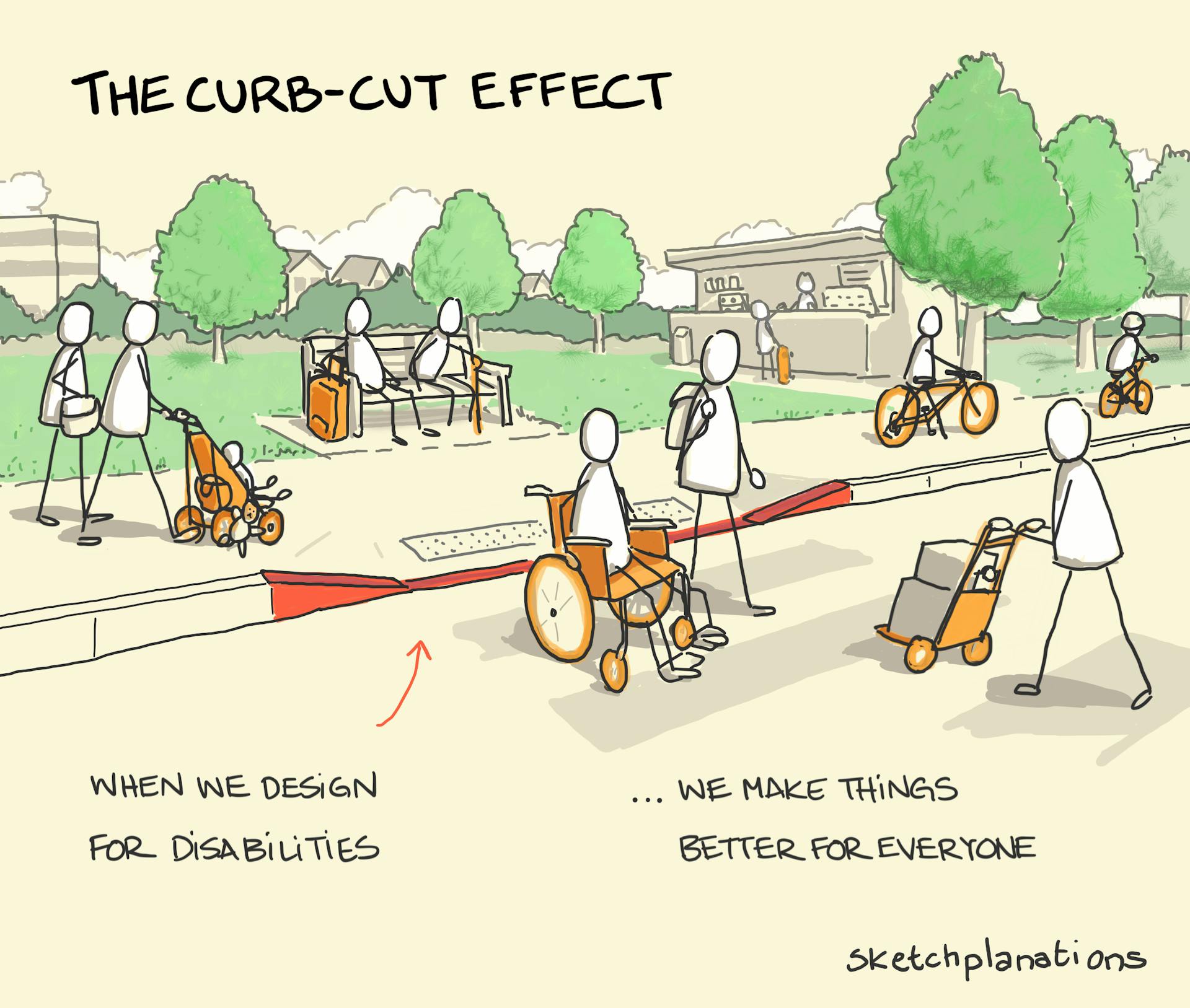
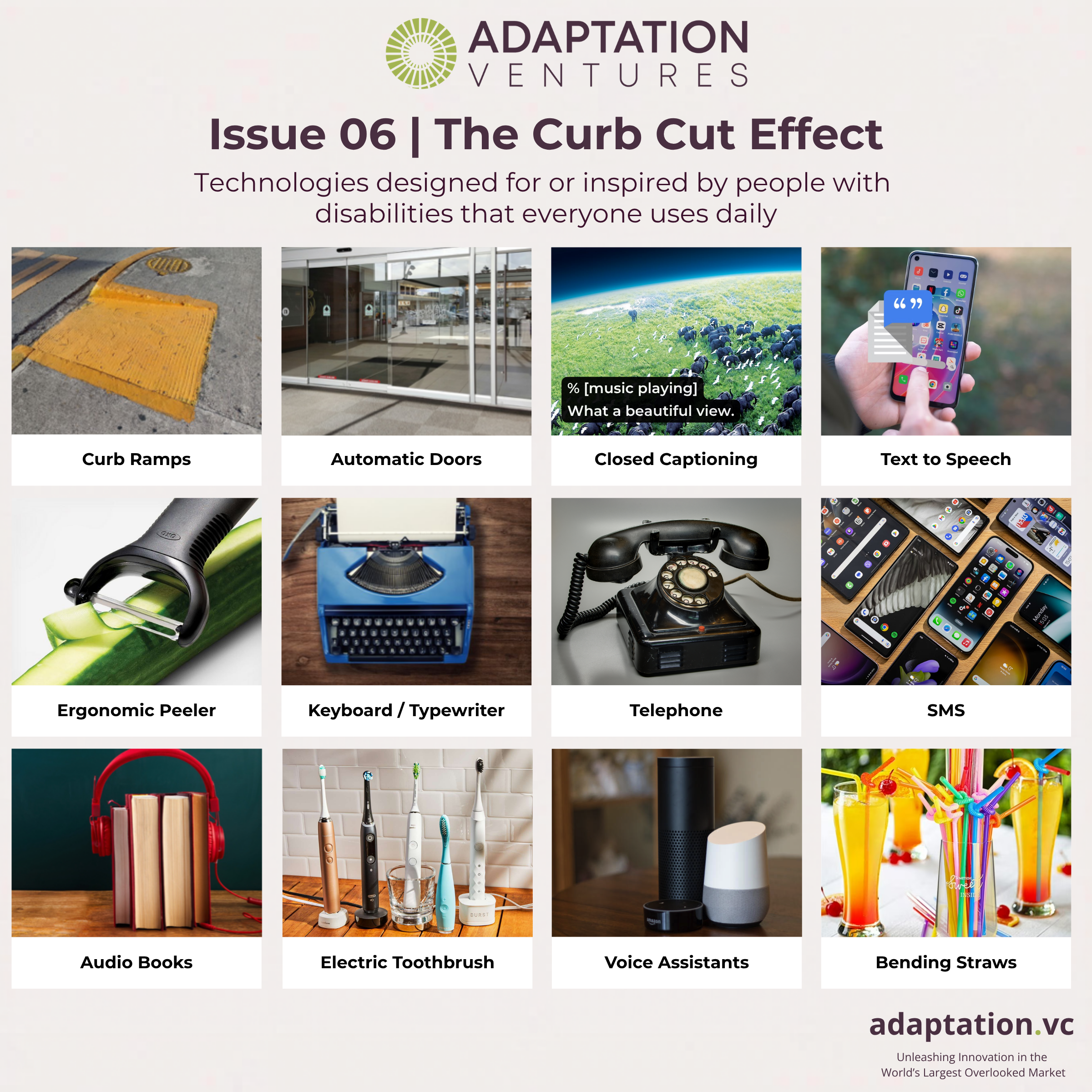
That is the Curb Cut Effect in economic form. When you solve a disability problem well, you often solve a broader human problem too. The curb cut was built for wheelchair users, but it also helps parents with strollers, travelers with luggage, and delivery workers with carts. Captions help Deaf users and people watching on mute. Voice interfaces help people with limited mobility and people who are driving or cooking. Accessibility starts with a specific need, then expands into a better pattern for everyone and even larger markets.
"Niche" was always the wrong word. The better word is "concentrated". Disability markets have concentrated pain. It is not a marginal productivity upgrade. It is the difference between communicating and not, working and not, living independently and needing support, diagnosing early and diagnosing late. That kind of pain changes behavior. Families search when the system fails them. Caregivers try tools that give them time back. Clinicians and payers engage when the cost of not solving the problem becomes impossible to ignore.
This does not make the market easy. It makes it real. Hard distribution is not small demand. Fragmented buyers are not indicative of a weak willingness to pay, especially with an estimated $18T in annual spending power for people with disabilities and their supporters. A founder who understands the user, knows the workflow, can navigate the buyer, and can solve an oxygen-level problem is not entering a niche market. They are entering a market others failed to understand. That misunderstanding creates the opening.
Why software alone is not enough
There is a quiet fatigue in the disability community, and it is worth discussing. People with disabilities have been promised the future many times: apps that did not understand their lives, devices that overpromised, and "revolutionary" tools that worked in a demo and fell apart in a kitchen or a clinic. When you have been sold the future a dozen times, you stop being dazzled by a slick interface and start asking whether the thing actually works. That skepticism is rational, and it tells you the bar is not novelty. The bar is reliability in the real world. Founders don't need to have all the features at launch, but the features must solve actual human problems.
Software-only solutions often struggle to clear that bar, for three reasons.
First, mainstream digital products (somehow) still have real accessibility gaps: interfaces that screen readers cannot parse, contrast that fails for low-vision users, missing or wrong captions, workflows that assume a body and an attention span not everyone shares. Layering another app on top of an exclusionary baseline does not fix the underlying problem.
Second, AI inherits human bias, including bias against disability. Penn State researchers found that trained AI models exhibit a learned, often implicit bias against disability, absorbed from their training data. It shows up in hiring tools, moderation, and ranking systems, which is exactly why the NIST AI Risk Management Framework treats fairness, validity, and harm mitigation as core requirements rather than afterthoughts.
Third, many of the hardest problems in disability are not screen-bound at all. A screen can remind you to take a medication, but it cannot help you grip the bottle. It can transcribe a conversation, but it cannot help you hear it in the room. It can schedule therapy, but it cannot help you regulate, move, or breathe. The screen is an interface to the world, not a substitute for it. Trust, workflow, and the body keep pulling the problem off the screen and back into the world.
The case for hardware
If software is becoming abundant, why lean toward the thing that is famously harder to build? Because the gap between hard and impossible has narrowed.
We are careful here: there is no single magic cost curve that makes all hardware cheap overnight. Tooling, certification, and supply chains are still real. But the friction from idea to working prototype has fallen, and several forces compound. Rapid prototyping and additive manufacturing have moved into the mainstream of product development, shortening iteration cycles and lowering the cost of being wrong early. AI is now embedded in the build process itself, in generative design and simulation, in sensing and perception, and in edge intelligence that lets a device reason locally. Cheaper sensors and compute, mature robotics components, and a deep IoT ecosystem let a small team assemble capabilities that once required a corporate R&D budget.
And when hardware works, the economics can be excellent. At Adaptation Ventures, we regularly see hardware companies showing 80-90% gross margin potential.
We are deliberately not stating high margins as a law of hardware, because they are not. Many hardware businesses run thin. But in our own observations, devices with proprietary design, embedded software, consumables, or a defensible clinical position can reach margin profiles that look more like software than commodity electronics. When that happens, the result can be a profitable, durable business rather than a cash furnace. There is also a second path: a company can run higher-margin and lower-volume to build a strong, profitable core, or scale globally at lower margin and higher volume to maximize reach. In disability markets, both can be right, and the choice itself can be an advantage.
Hardware is still hard. But hard, profitable, and defensible is a very different proposition than easy, cheap, and copyable. Perhaps this is why between Q1 and Q2 of 2026, Carta proclaimed hardware as the quiet winner and that cash raised by hardware startups rose 110.4%. Investors are certainly catching on.
Why disability hardware is especially compelling
Now put the two threads together. The physical world is where disability lives, and hardware is getting more buildable. That intersection is the thesis.
Look at where the real problems sit. Mobility is physical. Communication, for many, runs through a device. Sensing and monitoring require something on or near the body. Diagnostics and caregiving happen in the world, not in the abstract. These are not problems you solve fully from inside a browser tab. And the unmet need is enormous: the WHO and UNICEF Global Report on Assistive Technology found that access to assistive technology is one of the largest unmet needs in global health, with hundreds of millions of people lacking the devices they need to move, see, hear, communicate, and live independently. That is not an adjacent market. It is a structural gap in how the world is built.
Because of the Curb Cut Effect, hardware that genuinely serves a disabled user tends to serve a much wider population too. A device designed for limited dexterity is often easier for everyone. A communication tool built for nonspeaking users can unlock new interfaces for the mainstream. The specificity is not a ceiling. It is a starting point.
The most exciting founders in this space are already here
One reason we are confident, not merely hopeful, is that we are not waiting for the right founders to appear. We are already meeting them, and they come from more directions than the old venture stereotype predicts:
- Mechanical and hardware engineers who have spent careers making physical things work, now pointed at human problems.
- Hackers and tinkerers who treat a failed build as data and reach a working device faster than a committee can meet.
- Domain experts who understand a condition, workflow, or reimbursement path deeply enough to see the gap others miss.
- Disabled and neurodivergent founders building for their own lives, who cannot be fooled by a demo that would not survive a real day.
- Clinicians, caregivers, and operators who have watched the system fail people in real time and know how to ship physical products without losing momentum.
What unites the strongest of them is a specific combination: lived urgency plus technical competence. The urgency keeps them honest about whether the product helps. The competence lets them build something that works in the world, not just in a pitch. That pairing is rare, and it is exactly what this moment rewards.
Funding and scale are changing
A decade ago, the strongest argument against hardware was that it was harder to fund and scale. That argument is weaker now, on both counts.
On capital, there is a deep, underused well of non-dilutive funding for exactly this kind of science-heavy work. NIH SBIR and STTR programs fund early-stage R&D at small companies, which suits diagnostics and health hardware that needs evidence before a sales team. NSF's America's Seed Fund backs medical device innovation across diagnostics, rehabilitation, wearables, prototyping, and manufacturing processes. Capital that does not cost equity is a real advantage when you are de-risking a physical product in preparation for institutional investment.
On the build side, the prototype-to-production gap that killed so many startups is now actively staffed. FORGE helps physical-product startups move from prototype to full-scale production and connects them with manufacturers and suppliers across the Northeast.
Distribution is changing too. Disability hardware does not have to be sold one unit at a time. Nonprofits, aging and caregiving networks (e.g. AARP), clinicians, and payers are concentrated channels to the right users, and events like CES and SXSW now give physical-product startups real visibility. That connects to a measured point about exits: an early-stage health hardware company may not need to build a massive sales and support organization on its own. If it reaches durable product and regulatory proof points, it becomes attractive to strategic acquirers who already have that muscle. M&A is never guaranteed, but it changes the shape of what a hardware company must build before it can win.
Why past hardware startups struggled
We are bullish, not naive. The graveyard of hardware startups is real, and the lessons are worth taking seriously without dunking on the founders who took the swings. A few stand out.
Jibo, the social home robot, raised nearly $73 million, shipped late, cancelled overseas orders over localization, met a wave of far cheaper smart speakers, and eventually sold off its IP. Anki raised around $200 million and still shut down after a strategic financing fell through; its leadership said it lacked the funding to support a combined hardware and software business and bridge to its roadmap. And in health hardware specifically, evidence matters: the FTC refunded almost $3.9 million to purchasers of the Quell wearable after alleging its pain-relief claims were unsupported and deceptive.
The pattern is clear. These companies were often too early, overcapitalized before product-market fit, prone to scope drift, and caught off guard by distribution, supply chains, and the relentless cash intensity of running hardware and software at once. Some leaned on claims their evidence could not support. None of that is an argument against hardware. It is an argument for building it differently: capital efficiency, sharper focus, earlier proof, and honest claims.
What is different now
So what changed? Not the difficulty. Hardware is still hard, and that is partly the point. When a thing is hard to build, copy, and fake, difficulty stops being only a cost and starts becoming a moat. In a world where generic software is abundant, the hard physical thing is scarce by construction.
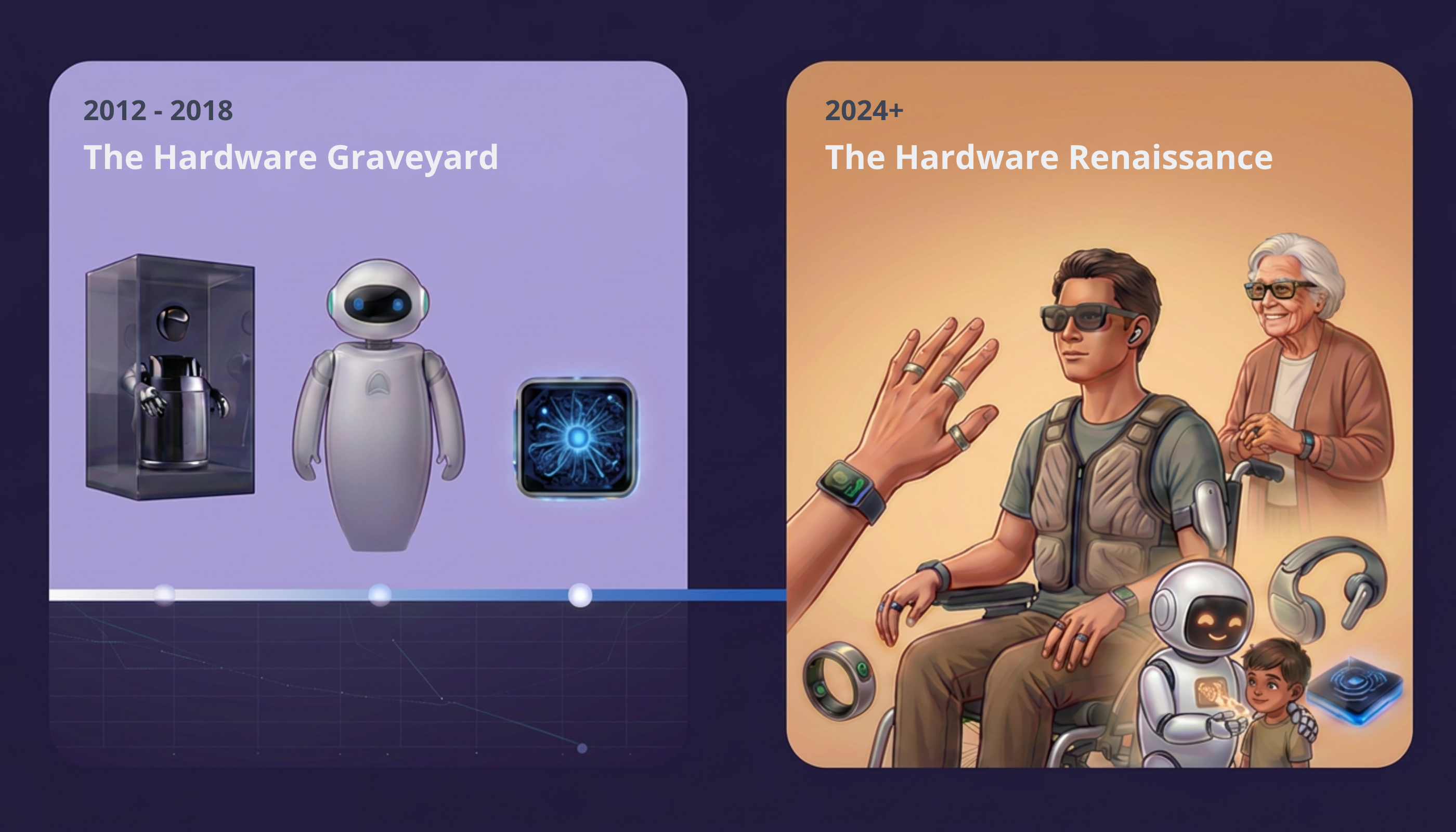
Consumer behavior is also shifting. Google Glass became the cautionary example for consumer smart glasses, and Google ultimately stopped selling Glass in 2023. For years, that looked like proof that people would not wear computers on their faces. Then Ray-Ban and Meta changed the story: EssilorLuxottica said revenue from Ray-Ban Meta smart glasses more than tripled year over year in the first half of 2025. The lesson is not that wearables were a bad idea. It is that timing and execution decide everything.
Underneath that shift, the enabling technologies matured all at once: capable AI, real edge compute, cheap and accurate sensors, a deep IoT ecosystem, more affordable robotics, and better diagnostics. Each was a research project a decade ago. Together, they are now readily available.
And there is a demographic force that makes physical-world products urgent. The Bureau of Labor Statistics projects that home health and personal care aides will be among the fastest-growing occupations, with hundreds of thousands of openings each year, far more than the current workforce can fill. When demand for care outstrips the people to provide it, hardware that helps becomes essential infrastructure, not a luxury. Hardware that safely replaces a dangerous task, augments a caregiver so one person can help more people well, or fills a labor gap no amount of hiring will close sits at the intersection of high demand and high impact. In disability and caregiving, that is the center of the problem.
Why Adaptation is bullish
We are not bullish because hardware suddenly became easy. It did not. We are bullish because three things are now true at once, and that combination is rare.
The hard parts of hardware are more manageable than ever. Prototyping is faster, components are better, AI is embedded in design and sensing, non-dilutive capital is available, and the prototype-to-production gap is now supported. The friction did not vanish, but it is navigable.
Software-only moats are less reliable. As AI makes building software faster and more accessible, simply being able to ship an app matters less. Scarcity is moving toward trust, data, workflow, lived experience, and physical-world integration.
And the physical-world needs in disability, neurodivergence, caregiving, and diagnostics are enormous, urgent, structurally underserved, and awaiting $18T in spending power. They live in the body, the home, and the clinic, not on a screen, and they are growing as populations age and care labor grows scarce.
Put those together and you get our conviction. The ethereal got crowded. The material got venture scalable. When software gets cheap, the physical world gets interesting, and the place where those facts collide most powerfully is the work we care about most: hardware that helps real people move, communicate, sense, recover, and live.
Let us compare notes
If you are building, funding, manufacturing, prescribing, caregiving, or operating anywhere near this thesis, in hardware, robotics, or assistive devices for disability, neurodivergence, caregiving, or diagnostics, we should talk. The material world is where the hardest, most human problems live. We think it is where the next great companies will be built.
So here is the only question that matters: what are you building?
Thank you for being part of the Adaptation Ventures journey.
Best, The Adaptation Ventures Team
This journal is for informational purposes only, is not a prospectus, may not be relied on as legal, tax, securities or investment advice and does not constitute an offer to buy or sell interests in Adaptation Ventures Fund I (the "Fund").
Related links/resources shown on page:
- "Learn About Our Process" / Apply — https://form.jotform.com/252368073782060
- Newsletter signup module (email field, no distinct URL)
- LinkedIn — https://www.linkedin.com/company/adaptation-vc
No explicit "related essays" module was returned by the fetch for this page.