Newsletter - Issue 16
November 2026 Newsletter
HapWare makes TIME's Best Inventions, Abby Care raises $82M to pay family caregivers, Envision winds down, and what Louis Braille's six dots still teach builders
October brought good news close to home. HapWare, one of our portfolio companies, closed an oversubscribed pre-seed round that we led, and TIME named its ALEYE wristband one of the Best Inventions of 2026. Caregiving drew the month's biggest check, with Abby Care raising $82 million to train and pay family members as certified caregivers. PRC-Saltillo bought an AI tool that saves teachers hours making classroom communication boards, and Envision, an early maker of smart glasses for blind users, said it will wind down after competition from Apple and Meta. On policy, states are getting ready for Medicaid work requirements in January, and HHS announced $35.8 million in new disability research grants.
Our Value Proposition
Adaptation Ventures is an early-stage venture capital firm that invests in next-generation companies building disability, neurodivergence and health technology to maximize human independence and potential for two billion people with $18 trillion in spending power.
- 2 billion people globally live with disabilities; nearly everyone will eventually use adaptive technology
- $18 trillion in annual spending power is concentrated among people with disabilities and their families, and they show 3x the customer loyalty of the average buyer
- 9x ROI for every dollar invested in assistive technology as people gain independence and potential, engage in activities, excel at work, raise families and more.
Story of the Month: Louis Braille and the Six Dots on Every Elevator
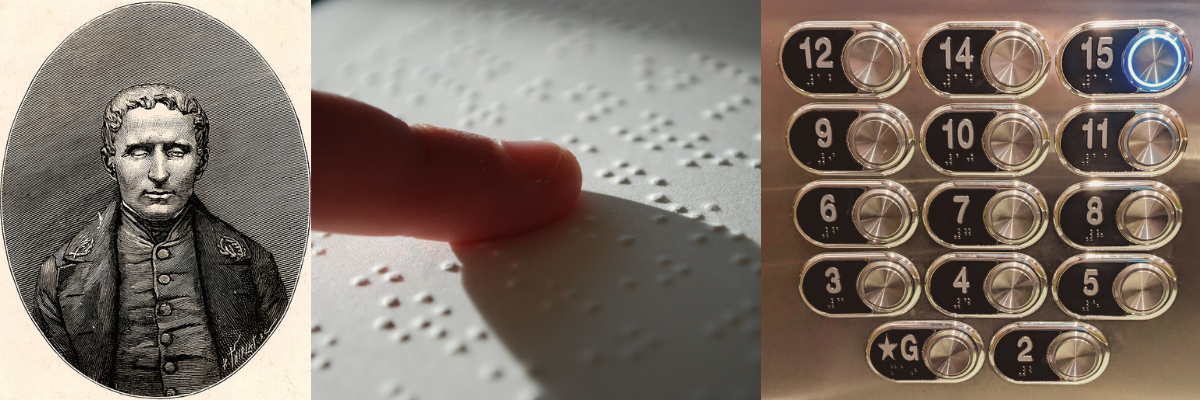
If you work in an office building in the United States, you pass braille every day. The ADA Standards require it on signs for permanent rooms like restrooms and conference rooms, on exit stairway doors, on elevator floor buttons and car controls, and on rail station signs (U.S. Access Board). The name belongs to a person, and his story says a lot about how assistive technology gets adopted.
Louis Braille was born in Coupvray, east of Paris, in 1809 and lost his sight at three after an injury (Library of Congress). In 1821, while he was a student at the Royal Institute for Blind Youth in Paris, an army captain named Charles Barbier visited to show off "night writing," a code of up to 12 raised dots built so soldiers could pass messages in the dark. It was based on the 36 sounds of spoken French, couldn't handle spelling or punctuation, and was slow to read. Braille spent ages 13 to 16 reworking it. By 15 he had a six-dot cell small enough for one fingertip, with 64 combinations covering letters, numbers, punctuation, and common words (AFB).
A later director of the school, Pierre-Armand Dufau, banned it. His assistant, Joseph Guadet, came around, and at the dedication of the Institute's new building in February 1844 he staged a demonstration. One student wrote out a poem dictated by a visitor, and another, brought back into the room, read it aloud (AFB). Braille died of tuberculosis in 1852 at 43. France adopted his system as its official one two years later (NFB via Duxbury Systems).
Braille by the numbers today
The often-quoted figure that fewer than 10 percent of blind Americans read braille comes from a 2009 National Federation of the Blind report (NFB). A 2022 review in the Journal of Visual Impairment & Blindness found the data to count braille readers doesn't exist (Mississippi State NRTC).
The employment data is clearer. A 2011 survey of 1,056 blind and low vision adults found 58 percent of braille readers were employed, compared with 44 percent of people who didn't read braille, and the braille readers earned about $11,000 more a year (Mississippi State NRTC). That's a correlation, not proof, but later studies keep finding it.
Why this matters to us
We invest in new ways for people to send and receive information: touch, sound, symbols, vibration, and signals read from the brain. Braille is the oldest proven example, and it shows what any new code needs before it's useful: someone to teach it, materials to read, and a world that builds around it. The ADA handled the third. The first two still lag, and cost is part of the reason. APH's Monarch, a 10-line braille display, costs $15,500, and a standard single-line display runs $9,000 and up (APH, Braille Monitor). Allyant's purchase of Braille Works, which we covered last month, shows there is still a business in producing accessible formats.
October's news follows the same pattern. HapWare's ALEYE turns facial expressions into vibration patterns its users learn to read, and PRC-Saltillo bought Glint so teachers can make communication boards in a child's own symbols in seconds. Both are below.
Funding Rounds: HapWare, Caregiving Money, and Brain Interfaces
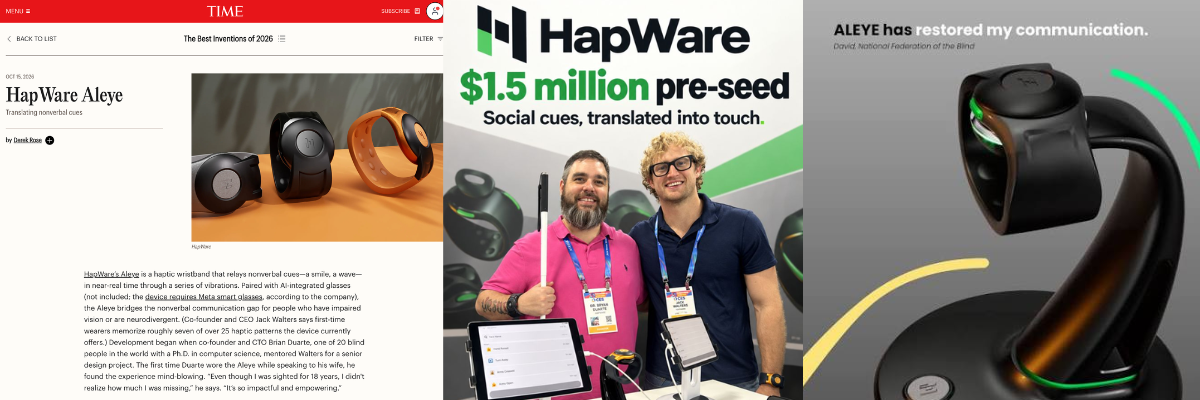
We'll start with one of our own. HapWare closed an oversubscribed $1.5 million pre-seed round led by Adaptation Ventures, with participation from Sidecut Ventures, Mines Venture Fund, Avesta Fund, The Pitch Fund, and others (PR Newswire). The same week, TIME named its ALEYE wristband to the Best Inventions of 2026 list in Accessibility (TIME). ALEYE works with Meta smart glasses or a phone camera and turns facial expressions, gestures, and body language into vibrations on the wrist, so people who are blind, low vision, deafblind, or neurodivergent can follow the nonverbal side of a conversation. Preorders are open with a refundable $59 deposit toward a $359 price, and it ships in 2027. Congratulations to Jack Walters, Dr. Bryan Duarte, Dr. Gabby Pangelinan, and the whole team.
Caregiving drew the month's biggest check. Abby Care raised an $82 million Series C led by Transformation Capital, with CVS Health Ventures, Frist Cressey Ventures, and Pivotal Ventures joining Khosla, Thrive, and Sequoia (Fortune). Abby operates as a Medicaid provider that trains family members to become certified, paid caregivers for relatives with complex needs. CVS Health Ventures' Justin Brock told Fortune that traditional private-duty nursing programs fill only 65 percent of the shifts families are authorized to receive. The gap starts before anyone gets a shift: KFF counts about 650,000 people on waiting lists for Medicaid home and community-based services across 40 states, with an average wait of 34 months (KFF). Abby is betting the person already in the house can cover much of that care and get paid for it.
CVS Health Ventures also backed Baba's $40 million Series A, led by FirstMark Capital (Capital.com). Baba gives Medicare and Medicaid members a human team of care coordinators and licensed therapists, supported by AI, to keep care connected across specialist visits, hospital discharges, in-home support, housing, and transportation. Anyone who has managed a parent's care knows how much of the work is phone calls and forms, and Medicaid's new rules will add more (see below).
Brain-computer interfaces kept moving. Bridge Neurotech came out of stealth with $13.5 million from General Catalyst and others for a wearable ultrasound device, close to a pair of headphones, that tracks blood flow in the brain without surgery (The Next Web). Paradromics announced on October 26 that the FDA approved dropping the rule that participants in its Connect-One speech study live within a four-hour drive of a trial site (Business Wire). Neuralink reported that an ALS participant reached 75 words per minute in the first week, close to conversational pace, though those are company numbers, not peer-reviewed results (Tesla North).
A few more October rounds worth knowing:
- Blue Arbor Technologies raised a $10.5 million Series A led by Ottobock for RESTORE, a neuromuscular interface that lets people control a prosthetic arm's fingers, wrist, and elbow at the same time. It has FDA Breakthrough Device designation, and a strategic lead like Ottobock gives it a route to patients (O&P Edge).
- Coherence Neuro raised $45 million from Founders Fund and the OpenAI Startup Fund for an implant that tracks brain tumors and uses mild stimulation to slow their growth, starting with glioblastoma (MobiHealthNews). It sits at the edge of our thesis, but OpenAI's money in brain implants says a lot about where the field is heading. The CEO told WIRED its contracts give OpenAI no access to brain or health data.
- SedMed, based in Milford, Connecticut, raised $4 million led by 108 BioCapital for a toilet lift that runs without electricity (Startup Researcher).
M&A and Exits: AAC, Home Sleep Testing, and Vision
PRC-Saltillo, one of the largest names in augmentative and alternative communication (AAC), acquired Ner Chat, the startup behind Glint (PRC-Saltillo). Glint lets teachers and therapists type a short prompt and get communication boards, visual schedules, and social stories back in seconds, shareable in more than 50 languages. PRC-Saltillo will add the symbols children already use in LAMP Words for Life and Unity, so a classroom board matches the device a child uses at home. Terms weren't disclosed, and Glint keeps its brand.
This is the deal we'd point founders to this month. Getting an AAC device to a child is hard, and keeping it in use across the classroom, therapy, and home is harder. Much of that work falls on teachers making materials by hand, and an established AAC company just paid to give them those hours back.
Beacon Biosignals acquired Snap Diagnostics on October 22 (Startup Researcher). Snap ships home sleep tests to patients in all 50 states and bills Medicare and commercial insurers directly, which more than doubles Beacon's patient reach. Beacon plans to offer EEG-based home sleep testing through that channel starting in 2027. A company with strong brain-monitoring technology bought the billing, logistics, and ordering clinicians it needed to reach patients.
Alcon agreed to buy Neurotech Pharmaceuticals for $550 million plus sales milestones, gaining Encelto, the only FDA-approved treatment for MacTel type 2, an eye disease that causes vision loss (Glance). It's a therapy rather than a device, but it's a strong exit in vision loss.
Two deals we covered last month moved forward. Oregon's health authority accepted Hanger and Numotion's complete notice on October 19, one of several state reviews, and Hanger still expects to close in the fourth quarter (Oregon Health Authority). The European Commission's provisional deadline to rule on Amplifon's DKK 17 billion (about €2.3 billion) purchase of GN Hearing is November 6 (MLex).
Big Tech and Accessibility: Free Features Squeeze a Pioneer
Two October stories belong together. On October 1, Google made Guided Vision live in Gemini Live on Android. It describes what the phone's camera sees in real time for blind and low vision users, and it was built with Aira and tested by more than 1,000 of Aira's users (Google). Four days later, Envision, the Dutch company behind the Envision AI app and smart glasses priced from $1,899 to $3,499, said it will stop product development at year-end unless it finds a partner (The National). The founders pointed to competition from Apple and Meta, and said the 300 million blind and low vision people worldwide look like a big market on paper, while the number who pay is far smaller.
We say this to founders often. Once the platforms give a capability away, a startup needs something they won't build: training and support, reimbursement, a payer relationship, or a use case too specialized for them. HapWare's ALEYE is built to work with Meta's glasses, not against them.
Disability on the Public Stage
Medicaid work requirements will be decided by paperwork. The rules take effect nationally by January 1, 2027. Adults 19 to 64 in applicable states will need 80 hours a month of work, school, work programs, or community service, with exemptions for people who are disabled or medically frail (CMS). CMS has since given states an optional framework for deciding who counts as medically frail, and some states had to redo their plans (Healthcare Brew).
Nebraska started early, and its numbers show where people fall through. Of 533 people denied at renewal in July and August, 490 lost coverage for not sending in information the state asked for, and 43 for not meeting the requirement (ClearHealthCosts). The National Council on Disability lists the barriers, from providers who won't fill out forms to appointment waits, transportation, inaccessible offices, and cognitive disabilities (NCD). For founders in benefits access, care coordination, and home care, the first half of 2027 is the window.
NCD's annual report card. The National Council on Disability's 2026 Progress Report, released October 7, credits historic gains in disability labor force participation. It also flags delayed accessibility rules and bills that could weaken the ADA, and warns that more than $900 billion in federal Medicaid cuts through 2034 leave optional home and community-based services exposed (NCD, full report).
$35.8 million for disability research. On October 28, HHS announced 68 grants totaling $35.8 million through its disability research institute, NIDILRR (HHS). The largest share, $8.4 million, funds 14 spinal cord injury model system centers. Thirteen Small Business Innovation Research awards worth $2.3 million back early products, including a motorized hand exoskeleton, a bionic arm, and accessible medication dose markings. SBIR is non-dilutive money for exactly the companies we meet at pre-seed, and more founders should apply.
Social Security's 2027 numbers. Benefits rise 3.6 percent in January. The maximum SSI payment for an individual goes to $1,029 a month, and the earnings limit for blind beneficiaries goes to $2,950 a month (SSA).
Looking Ahead to November
November is National Family Caregivers Month, and the Caregiver Action Network's theme this year is "Care Connects Us" (Caregiver Action Network). Here's what we're watching:
- November 6: The European Commission's provisional deadline on Amplifon and GN Hearing.
- November 12 and 13 (Barcelona, Spain): Breaking Barriers Congress on assistive technology and AAC (Breaking Barriers).
- November 16 (Bethlehem, PA): Lehigh University's Summit on AI-Enabled Assistive and Rehabilitation Technologies (Lehigh).
- November 17 (virtual): National Disability AI and Enabling Technology Summit, 2 to 5 p.m. Eastern, free (My Tech For All).
- November 18 (Toronto, ON): Canadian Disability Tech Summit, with more than 400 people who build, fund, buy, and use disability technology.
- November 18 and 19 (London and online): AbilityNet's TechShare Pro, in its 10th year (AbilityNet).
- Further out: Medicaid work requirements take effect by January 1, and ATIA moves to a Friday to Sunday schedule in Orlando, January 22 to 24 (ATIA).
Thank you for being part of the Adaptation Ventures journey.
Best, The Adaptation Ventures Team
This journal is for informational purposes only, is not a prospectus, may not be relied on as legal, tax, securities or investment advice and does not constitute an offer to buy or sell interests in Adaptation Ventures Fund I (the "Fund").