
Newsletter - Issue 09
July 2026 Newsletter
A deaf-communication platform raised at a $500M valuation and a Paralympian won a Senate primary. June was a good month for proving that maximizing independence, potential, and dignity can pay.
June was busy. A communication platform for deaf and hard-of-hearing users raised at a $500M valuation, with lessons for startups about regulation and recurring revenue. Hearing care went through a big round of consolidation. Capital kept moving into vision restoration, neuroprotection, and the infrastructure side of home care. A two-time Paralympic gold medalist won a U.S. Senate primary. And we published an essay arguing that when software gets cheap, the physical world, where disability actually lives, gets a lot more interesting.
We talk about maximizing independence, potential, and dignity – and June brought this to the forefront in many exciting ways.
Our Value Proposition
Adaptation Ventures maximizes human independence, potential, and dignity by investing in next generation disability, neurodivergence, caregiving, and diagnostic tech companies that serve 2B people with $18T in spending power.
- 2 billion people live with disabilities globally, and nearly everyone will use adaptive technology at some point in their lives
- $18 trillion in spending power is controlled by people with disabilities and their supporters, who have a much higher customer lifetime value and brand loyalty than average
- For every $1 spent on assistive tech, there is a 9x ROI as people gain independence and potential, engage in activities, excel at work, raise families, and more
- The assistive tech industry alone is projected to be $112B by 2034.
Deal of the Month: Rylo, formerly Nagish, and the $500M moat building process
Rylo, the company you might still know as Nagish, raised $85 million at an estimated $500 million valuation. General Catalyst and Canaan led, and every existing investor (Cardumen, Vertex, Precursor, K5) came back in. Total funding now sits at $101 million, which is striking when you remember the company had raised only $16 million across its first two rounds. Management is targeting $100 million in revenue by the end of 2026 and more than $1 billion by 2028, after growing roughly 400% over the past year. It is already profitable.
The number is impressive. The harder, more useful exploration is why this worked and why a competitor would struggle to copy it.
Rylo builds real-time speech-to-text and text-to-speech that lets deaf and hard-of-hearing people make phone calls on their own, with no call center in the middle. Conversations get transcribed live across 50 languages, and users can type or speak while the app voices their words to the other side. It's a good and useful product, but perhaps doesn't explain the high valuation.
What likely drives that valuation up is the moat that is aided by regulation. In May 2024, Rylo got an FCC license to provide IP Captioned Telephone Service. Only six companies hold one, and Rylo is the only provider running fully on technology rather than human relay operators. That license lets a federally funded program pay the company between $1 and $8 per minute of conversation instead of charging the people who use it. The service is free for the user, and the government pays Rylo as a piece of regulated infrastructure. Even at a $100M run rate, founder Tomer Aharoni says, "we've only penetrated about 1% of the U.S. market," and that market runs to roughly 40 million deaf or hard-of-hearing Americans.
Why they won, the way we see it:
- Regulated, recurring revenue that doubles as distribution. Free for the user, reimbursed by a federal program, protected by a scarce license. This is the kind of structural advantage our latest essay argues has become rare: regulatory fluency, earned trust, and a painful problem that holds up in the real world.
- AI-native in a category built on human labor. "We're fighting hard to stay small and use AI as much as possible," Aharoni said. Thirty-two employees against billions in addressable spending.
- A clear second follow up play. Rylo bought Sign.mt at the end of 2025, adding real-time sign-language recognition and translation. Governments and companies spend about $4 billion a year on sign-language interpretation, and only about 5% of demand gets met because there are not enough interpreters. That gap is a huge opportunity for startups.
Rylo is a clear proof that a disability-first company built on lived need and regulatory depth can be hard to build, profitable, and defensible, rather than cheap and easy to clone.
Funding Rounds
This month's financing news was in the physical world, focused on problems of hearing, vision, the brain, mobility, and the home.
- Flourish, $500M Series A at a $2.5B valuation (June 4), backed by Jeff Bezos, Lux Capital, and GV. Founded by CTRL-labs creator Thomas Reardon, it builds brain-inspired, low-power AI, work that sits close to wearable BCIs and cognitive prosthetics.
- Nura Bio, $73.8M Series B (June 22), pushing SARM1 inhibitors that block axon degeneration in ALS. It goes after the disease process instead of the symptoms, and Sanofi Ventures joining signals real conviction from big pharma. While Adaptation doesn't invest in therapeutics, this is an exciting advancement.
- Vali Health, $6M Seed (June 17), an AI coordination layer that matches home-care agencies to clients with conditions like dementia and Parkinson's and cuts open shifts by 80%. This is infrastructure for the fastest-growing, least-built part of disability support.
- Kimba, $6.5M Seed (June 15 to 16), an AI scent-therapy sleep device built by a combat-injury and PTSD survivor, offering non-drug sleep support for veterans and neurodivergent users.
One regulatory milestone belongs next to the rounds. On June 11, Wave Neuroscience won the first FDA clearance for a personalized, EEG-guided neuromodulation treatment for PTSD, which removes the off-label barrier to payer coverage for roughly 13 million Americans affected each year.
M&A and exits: hearing, mobility, and strategic buyers
Exits and consolidation are how the "returns" half of "impact and returns" gets proven. Deal flow in disability and adjacent markets picked up steam.
- Hearing is consolidating fast. Recently, Amplifon, the world's largest hearing aid retailer, agreed to buy GN Hearing (ReSound, Beltone, Jabra Enhance) for about €2.64 billion, around $2.9B. It is the biggest hearing-industry deal in years, and it pulls retail and manufacturing under one roof for a population of roughly 1.5 billion people with hearing loss. Days earlier, edge-AI chipmaker Syntiant bought both Orosound and AudioSourceRE to build a full-stack, on-device AI audio platform – a clear bet that hearing AI is strategic IP. EQT-backed WS Audiology added 28 Benelux hearing clinics through acquisitions. The takeaway is that hearing platforms with real distribution now fetch multibillion-dollar prices.
- Mobility is being re-segmented. Ottobock is selling its Human Mobility wheelchair division to DHCare so it can focus on higher-margin prosthetics and neuro-orthotics. It tells you how big MedTech players think about disability hardware now. Commodity mobility lands with specialist care investors, while digitally enabled prosthetics draw the strategic premiums.
- Strategic buyers keep validating the category. Medtronic bought SPR Therapeutics, which makes non-opioid peripheral nerve stimulation for chronic pain, for $650M. It was Medtronic's third acquisition of 2026, following Boston Scientific's $533M purchase of Nalu Medical. Roche moved to acquire AI digital-pathology company PathAI in a deal worth up to $1.05B. Danaher completed its $9.9B purchase of patient-monitoring leader Masimo.
Big Tech and accessibility: what actually shipped
Last issue we covered the May rush of Global Accessibility Awareness Day announcements. June was about delivery, and about Apple's developer conference, WWDC 2026.
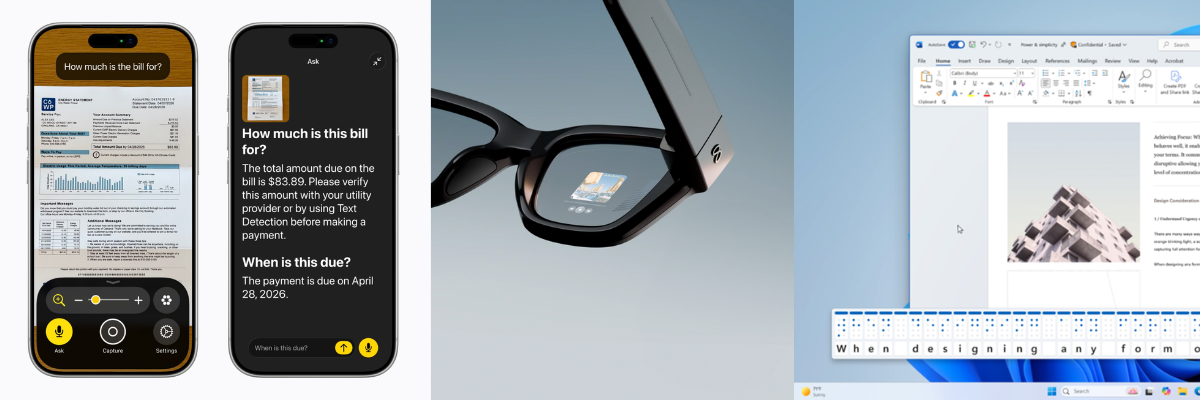
Apple confirmed that Apple Intelligence will drive a set of accessibility features shipping with iOS 27 this fall: richer AI image descriptions in VoiceOver, natural-language Voice Control for people with physical disabilities, summarization and translation in Accessibility Reader, and a stronger Magnifier. The pattern keeps repeating. AI sits between the user and the world and turns visual, motor, and cognitive demands into something easier.
Meta launched a cheaper Meta Glasses line at $299 on June 23, which widens the price options for AI glasses, and rolled out Be My Eyes Group Calling, a Be My Eyes service directory, and Captioned Calls across its Ray-Ban and Oakley devices. It also shipped a Wearables Device Access Toolkit that opens the hardware to outside accessibility developers. Google's June Pixel Drop sharpened Expressive Captions and expanded Voice Translate, and the Android XR audio-glasses ecosystem (XREAL Aura) opened reservations for a fall launch with Gemini-powered navigation and real-time sign translation. Microsoft shipped plug-and-play Narrator Braille support, including during out-of-box setup, so a deaf-blind user can set up a new PC alone for the first time.
One release outside Big Tech is worth your attention. Freedom Scientific's JAWS "Picture Smart" now reads handwritten documents and completed forms aloud, closing a paper-form gap that has frustrated blind users for a long time. And in adaptive gaming, Insomniac's Marvel's Wolverine, due in September, announced a full set of cognitive, visual, motor, and auditory accessibility controls, with trauma-sensitivity options included.
Disability on the public stage: a Paralympian on the Senate ballot
We flagged a story building in Iowa in our last newsletter, and it broke through this month. On June 2nd, Josh Turek won the Democratic U.S. Senate primary in Iowa. He is a 47-year-old state representative, a two-time Paralympic gold medalist in wheelchair basketball, and a lifelong wheelchair user born with spina bifida. He faces Republican Ashley Hinson in November.
Turek runs as a "prairie populist" and a "common-sense moderate," and his story stands on its own. By age 12 he had been through 21 surgeries. He scored more than 4,000 points in college before winning two golds and a bronze for Team USA. The part that matters to us is the lineage. Turek takes inspiration from, and has been endorsed by, former Iowa Senator Tom Harkin, who was the chief sponsor of the Americans with Disabilities Act.
That is the public representation COSP19 called for last month, in a single candidate. A visibly disabled man, mentored by the author of the ADA, on a major-party Senate ticket in the same year the law turns 36. Representation in the room where rules get written is its own kind of accessibility, and it shapes the markets we invest in.
From the Journal: Ethereal vs. Material
This month we published a new essay, "Ethereal vs. Material: When Software Gets Easy, Hardware Gets Interesting."
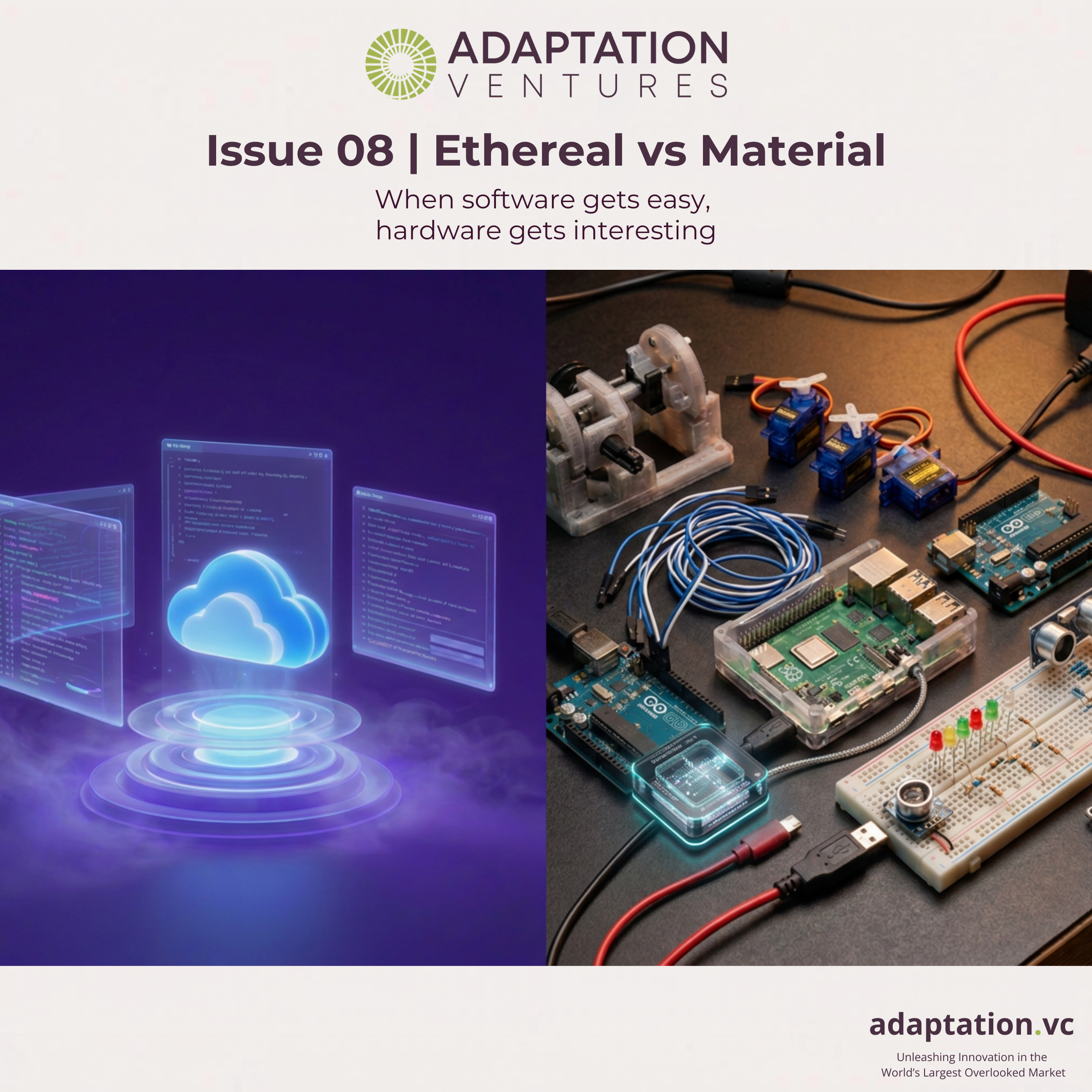
The argument runs like this. AI and no-code tools have made software far easier to build. In Stack Overflow's 2025 survey, 84% of developers use AI tools or plan to, and GitHub found Copilot users finished a task 55% faster. Easier to build also means easier to copy, so software moats are thinning. What stays scarce is different: trust, distribution, regulatory fluency, proprietary data, deep workflow knowledge, physical-world integration, lived experience, and the ability to solve a true human problem that survives contact with the real world.
That is where disability tech sits for over 2B potential users. Mobility, communication, sensing, diagnostics, and caregiving get solved in the body and the home, not in a browser. Hardware has also become far more buildable thanks to rapid prototyping, mature and plentiful components, and AI-assisted design, to the point where we keep seeing disability hardware companies with 80% to 90% gross-margins. Between Q1 and Q2 of 2026, Carta reported that cash raised by hardware startups rose 110.4%. As we put it in the essay, "the ethereal got crowded. The material got venture scalable."
What excites us: our essay is playing out in real capital (beyond our own, of course!). Rylo's regulated moat and the funding we covered above, with innovation being fueled across hearing, vision, brain, and the home also show us that when software gets cheap and copyable, the physical world gets interesting.
Adaptation in the Wild
COSP19 at the United Nations
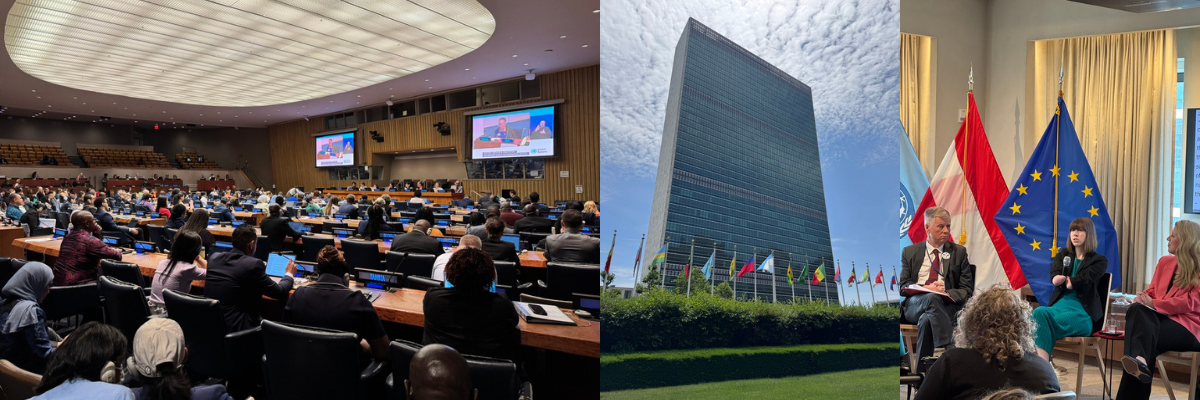
In June, Adaptation joined the disability community at the 19th Conference of States Parties to the UN Convention on the Rights of Persons with Disabilities (COSP19) at UN Headquarters in New York. The theme was "CRPD at 20" and the next phase of putting the convention into practice. The conversations ran straight through our thesis: autonomy and independence, care and support systems, accessible civic life, and public representation, the same themes now showing up in capital markets and on the campaign trail.
Brittany at the Austrian Mission
Brittany joined a panel, convened by Hezzy Smith and moderated by Professor Michael Stein of the Harvard Law School Project on Disability, at the Permanent Mission of Austria to the United Nations on the role of early-stage investing in advancing disability rights and the goals of the CRPD. Speaking alongside other investors and advocates, she made the case we keep coming back to: disability innovation is not charity or concessionary. It is one of the largest overlooked markets in the world, and early-stage capital, put to work with lived experience and conviction, is how this category gets built.
An adaptive fashion show at Positive Exposure
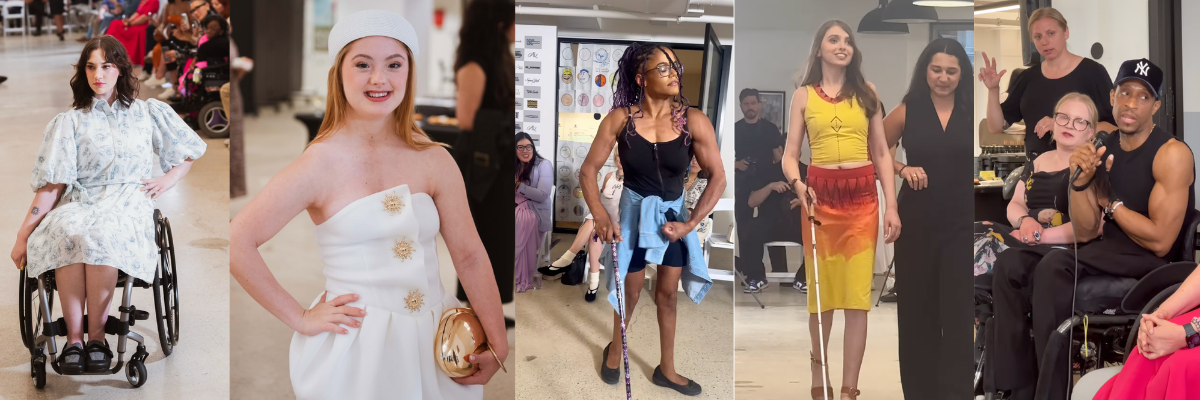
While in NYC, we took a brief, but on-message, break to attend an adaptive fashion show at Positive Exposure. The organization uses photography and the arts to change how the world sees people with disabilities, and how they see themselves. Adaptive fashion sits right where dignity meets design, clothing made for real bodies and real dexterity that supports real independence – but without sacrificing incredible, fresh looks that anyone would be eager to rock.
Photo Credits: Positive Exposure, Samanta Bullock, Leandro Justen
A note on the World Cup
Last issue we went long on how the 2026 FIFA World Cup is shaping up to be the most accessible major sporting event ever staged, with sensory rooms in all 16 stadiums, live sign-language interpretation, audio description, and haptic boards. The tournament is now underway across North America, so those features are out in the world. See our last newsletter for the full deep dive.
Looking ahead to July: the ADA turns 36
On July 26, 2026, the Americans with Disabilities Act turns 36, on a date that also marks National Disability Independence Day.
July events we're watching:
- NFB National Convention, July 3 to 8, Austin. The largest gathering of blind Americans, and a good read on assistive-tech adoption.
- National ADA Symposium, July 19 to 22, Phoenix. The main convening on ADA implementation and enforcement, well timed given the active litigation.
- AI Summit with Disability Services Australia, July 24, Sydney. AI's role in reshaping assistive technology, seen from outside the U.S.
- American Council of the Blind Conference, July 24 to 31, St. Louis.
- Disability:IN Global Conference & Expo, July 27 to 30, Dallas. The flagship business-and-disability event, anchored this year by the $675B consumer-market report.
Thank you for being part of the Adaptation Ventures journey.
Best, The Adaptation Ventures Team
This journal is for informational purposes only, is not a prospectus, may not be relied on as legal, tax, securities or investment advice and does not constitute an offer to buy or sell interests in Adaptation Ventures Fund I (the "Fund").