Essay - Issue 14
Nine Years
You can't outspend your body. Longevity spending on its own is a position with no hedge.
Short Story
Imagine this: You are on a stationary bike, deep into interval training, doing the kind of workout doctors and influencers tell you to do. Then you get dizzy, the worst headache of your life starts happening, your vision goes, your hearing dulls, and you begin to slur your speech - losing consciousness as an unexpected brain aneurysm ruptures, mid-pedal, while you are actively trying to add years to your life.
You're young, so the initial diagnosis is a migraine and the paramedics drive without their lights on to the regional hospital. The CT scan tells the real story and you are rushed, with everyone around you apologizing, to a different hospital. You remember scribbling to consent to open brain surgery. You don't remember most of what came next. You remember relearning how to walk. Relearning how to talk, how to read, how to string a sentence together in the right order. You had LASIK, but the bleed damaged your occipital lobe causing blurred vision which is disorienting. Despite that, you remember lying in a hospital bed on the Fourth of July, able to see the colors of fireworks through a window, feeling something close to hope for the first time since it all happened.
This happened to our Managing Partner, Rich Palmer. The afternoon he got on the bike, he was not part of the disability community. Minutes later, he was. Disability is a community you can join at any time. Nobody sends an application. Nobody warns you about the timing. One minute you are optimizing your workout, and the next you are learning to speak your own name again. Some things can be addressed with money - like getting vision surgically corrected after you exit your company, as Rich did, but many things become your "new normal".
Money doesn't help when nature strikes. Billionaire Dan Gilbert had his stroke at 57, on a private jet, in the middle of a career most people would call unstoppable. He had the resources to fly to the best neuro-rehab facility in the country and stay as long as it took. Years later, he still uses a wheelchair much of the time and has only recently taken a few unaided steps. Money bought him access to care. It did not buy back what the stroke took. You cannot outspend a disability. You can only prepare for the possibility that one is coming for you or someone you love.
That is the part of the conversation that rarely comes up at a longevity dinner. Everyone at the table is underwriting a bet on more years. Almost nobody is underwriting what happens if those years, or the years of someone they love, arrive with a body or a mind that no longer works the way it used to.
Disability is a community you can join at any time. Nobody sends an application.
Long Story
Why the title "Nine Years"?
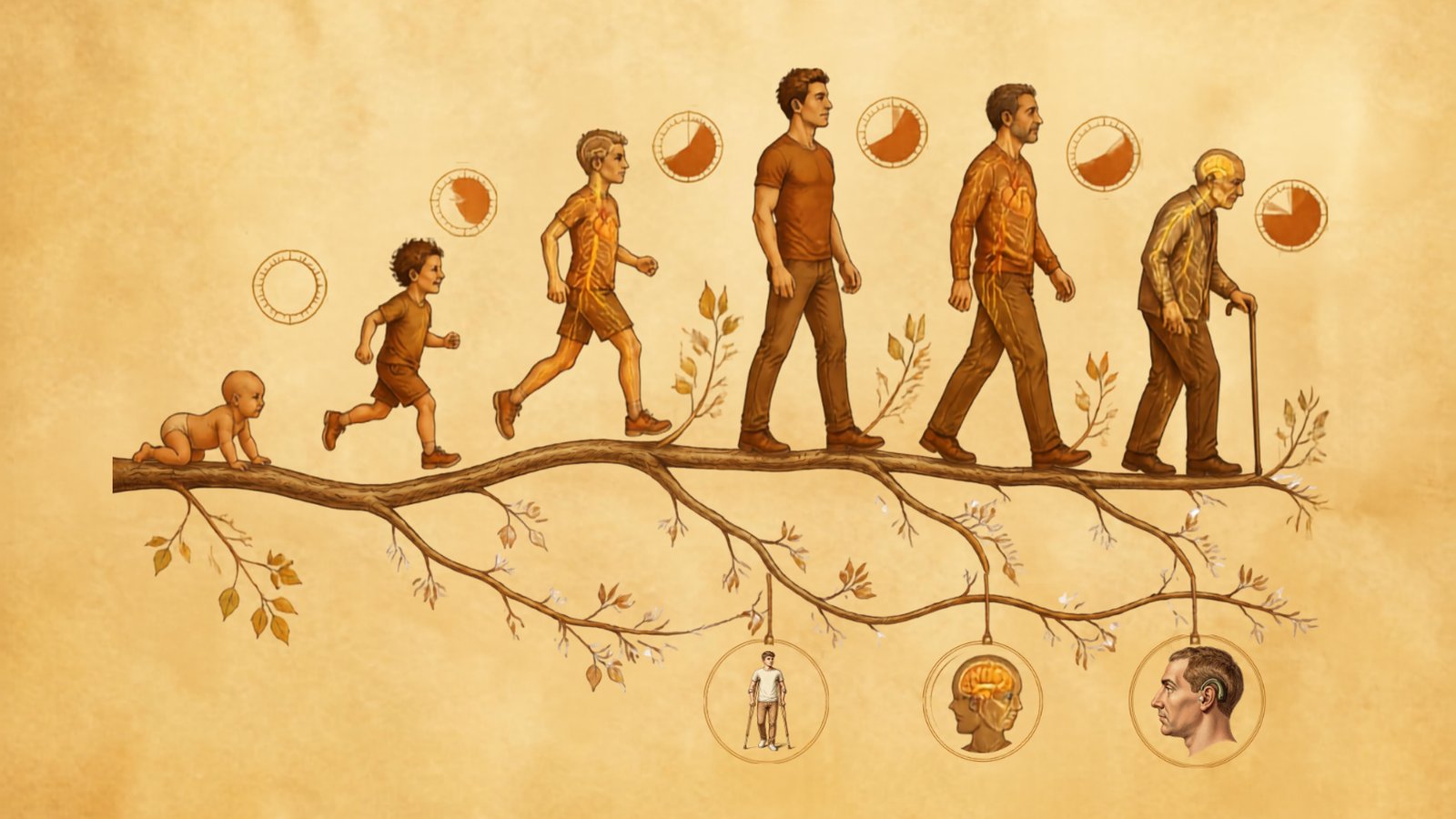
Lifespan is the easy number. It's on a chart, it goes up, and it makes for a good conference slide. Healthspan is harder: the years you get to live without a disease or disorder running the show. Gerontologist Kerry Burnight has spent her career studying older adults and noticed something the first two numbers miss entirely. People can live long. They can even live healthy, by the numbers, and still be miserable. She coined a third term for it: joy span, the years you spend enjoying being alive, built on connection, purpose, and a sense of agency rather than the absence of disease.
Multiply these three numbers - how long you live; whether your body still works the way you want; and whether you like being alive during those years - and you get something closer to what people want when they say they want to "live longer". Nobody wakes up wanting more years on a ventilator. They want more years that feel like the good ones.
The most important number in that equation is the scariest one: nine years. That's the global gap, in 2019, between how long the average person lives and how long they live in reasonably good health. A 2024 study in JAMA Network Open, covering all 183 WHO member states, measured it at 9.6 years, widened from 8.5 in 2000. Women's gap runs 2.4 years wider than men's. The United States sits at 12.4 years, the largest gap of any country in the study.
Those years are not a footnote at the end of a life. They are, by definition, years lived with a disease or a disability serious enough to limit how a person functions. Every drug, protocol, and biomarker in the longevity conversation is a bet on adding years to lifespan. The gap says a meaningful share of those added years will land inside the nine, not outside it. Optimize lifespan - without a plan for healthspan and joy span - and you are not extending a good life. You are extending the ending of one.
Optimize lifespan - without a plan for healthspan and joy span - and you are not extending a good life. You are extending the ending of one.
The community anyone can join, at any age
The nine-year gap makes disability sound like a problem that arrives at 75. It doesn't. It arrives whenever it arrives.
The CDC estimates that more than 70 million U.S. adults - roughly one in four - report a disability. One in six of your peers in their 30s and early 40s is already in the community. Live long enough, and it's close to a coin flip.
The pathways to having a disability are more common than you might realize (and certainly not addressed in longevity protocols). About 795,000 Americans have a stroke every year, and 38 percent of stroke hospitalizations are in people under 65. A 2025 analysis found nearly 10 million Americans sustained a traumatic brain injury in the past year. Add cardiac events, cancer treatment with lasting side effects, autoimmune disease, adult neurodivergence diagnoses, sports and car injuries, complications from a routine surgery, a fall on a set of stairs - none of those are edge cases. All of them are on the list of things that can move a person from one side of the disability line to the other in an afternoon.
Some of what's driving the older-age numbers gets missed because it doesn't look like an injury on a hospital chart. Sensory processing differences, memory and attention changes, and adult-onset cognitive shifts show up more, not less, as people age. Longevity science tends to define success as staying alive and staying independent, using a fairly narrow definition of independent. It rarely asks what independence looks like for a mind that processes the world differently than it did at 40.
The point isn't that disability is inevitable. It's that the odds of joining the community are high enough, and the on-ramps are common enough, that a longevity plan without a disability plan is a plan with the middle or last chapter missing.
The reality check
Before going further, it's worth pondering the question: Does any of the current longevity science add real days to a human life?
The surprising answer, as of today, is no. The FDA doesn't recognize aging as a treatable condition, so nothing can be approved with lifespan extension as its primary claim. Rapamycin extends lifespan reliably in animal models; it has not been shown to do the same in a completed human trial. Metformin's own aging trial, TAME, has been stuck in funding limbo for years. Dietary restriction remains the one intervention with real cross-species evidence, and it's a trade-off most people, understandably, won't make.
That hasn't slowed the spending. Family offices and high-net-worth individuals are already funding protocols with limited human data - at-home biomarker panels, peptide therapies, hyperbaric sessions, personalized supplement stacks - on the hope that the science catches up to the checks. Some of it may eventually prove out. None of it addresses what happens if the extra years arrive in a body that needs help.
Understanding why cells age is worth funding. But right now, in 2026, buying lifespan is not a product on the market - at any price. What is buyable, today, is better function inside the years you already have. That's a different market. It's the one Adaptation lives in.
The rooms where this money already convenes
Investors interested in longevity are not hard to find. They show up at the Longevity Investors Conference in Gstaad, Switzerland, an application-only event for roughly 120 investors and family offices in a room with 30-plus scientists and founders. The 2026 program features names like Dave Asprey, Dr. Aubrey de Grey, Dr. Steve Horvath, Dr. Nir Barzilai, Prof. Michael Levin, and Max Marchione, along with panels on supercentenarian research, epigenetic reprogramming, and the future of human performance. They show up at investor lunches tied to Davos and the World Economic Forum. Past sessions have featured David Sinclair, Bryan Johnson, and Peter Diamandis programming on gene therapy, senolytics, and the biology of exceptional longevity.
These are not obscure researchers. They are bestselling authors, top-ranked podcast hosts, and founders with a combined social following in the millions - the people most responsible for what the public, and increasingly the investors funding them, believe about what money can buy back from aging.
That megaphone is exactly why it matters that the field's own leaders don't fully agree on the story it's telling. In 2024, David Sinclair resigned as president of the Academy for Health and Lifespan Research - the field's own professional body, which he had led for less than a year - after other scientists, including Dr. Nir Barzilai, pushed back publicly on his claims of having reversed aging in animals. The complaint wasn't that the underlying research was worthless. It was that the story being sold to the public was ahead of the data. The same megaphone that helps raise billions for longevity has, so far, said almost nothing about what happens when those bets on more years land inside a body or a mind that is struggling.
That silence is deafening - pun not intended. What's missing from those agendas is disability, caregiving, and neurodivergence. It's not present at all. Across recent years of published sessions for the largest investor-facing longevity events, there is no panel on what happens to a family when a parent needs a wheelchair ramp, no session on caregiver burnout, no mention of the sensory and cognitive differences that show up more, not less, as populations age. The rooms spending the most on adding years to life have left almost no room on stage for what a meaningful share of those years will actually require.
The Milken Institute Global Conference is the closest exception, and it's worth discussing separately because it shows what's possible. Its Future of Aging program has run public panels on family caregiving, published a 2025 report on how employers can support caregivers, and put a dollar figure on the productivity cost of the current arrangement: about $33 billion a year. Even there, caregiving runs on a separate track from the longevity biotech that draws the cameras and the family offices watching from the audience. Caregiving gets a breakout room. Longevity gets the keynote.
Caregiving gets a breakout room. Longevity gets the keynote.
There is a small irony in that. The joy span researcher mentioned earlier has a framework that centers on four verbs: grow, connect, adapt, give. "Adapt" is right there, one of the four pillars she found that separates people who thrive in a long life from people who merely survive one. It's the same word we built a fund around, and it's the one word missing from the agenda at the events where the people funding the longevity movement gather.
The sandwich, and why it's tightening
If you are in your 40s or 50s reading this, there is a good chance you are already living the counterargument to a lifespan-only strategy, whether you realize it or not. Pew Research found 54 percent of Americans in their 40s have both a living parent aged 65 or older and a child they are raising or supporting financially. That's the "sandwich generation", and it is the exact age band where most serious LP capital sits.
Ask someone in that position what keeps them up and the answer rarely starts with their own biological age. It starts with a parent who fell last month and won't say how bad it was, a teenager who got an unexpected diagnosis, and a spouse managing both at once while also trying to hold down a career. Longevity science, even in its best-case future, extends the number of years a parent needs care and doesn't touch the number of years a child might need support. It stretches the sandwich. It doesn't shrink it.
The caregiving that results from this arrangement is not small or temporary. The 2025 AARP and National Alliance for Caregiving report puts the number of Americans providing unpaid care for a family member at 63 million, up 45 percent in a decade and contributing labor valued at more than $1 trillion a year at market rates. Nearly one in four American adults spend an average of 27 hours a week caregiving - most of them holding jobs.
That is the urgency case for moving capital now, not the abstract 2 billion people worldwide living with a disability, real as that number is. It is the fact that the people best positioned to fund the solution are often the same people already living the problem.
The put option
Here is the framing we would offer an investor that already understands options. A put option gives you the right to sell at a set price if things go wrong. You buy it not because you expect the crash. You buy it because the cost of being wrong without one is a lot higher than the premium.
Most investors and family offices already run this logic somewhere else in the portfolio. They hold treasuries against equity risk. They buy insurance on real estate they will probably never file a claim on. Nobody calls that pessimism. They call it fiduciary duty to their future and the next generation holding the wealth. Longevity spending on its own is a position with no hedge, built on the hope that biology cooperates and nothing goes wrong for another forty, fifty, sixty years. That is not how anyone would structure a stake in a public company. It should not be how they structure a bet on their own bodies and future. Yet that's exactly what a longevity-only allocation is: a leveraged long position on your own biology, uninsured.
Disability tech, caregiving infrastructure, and diagnostics are the closest thing to a put option a family has against the downside case of its own longevity bet. Permanent disability, progressive disease, episodic conditions, temporary injury: none of them are rare tail risks. They are closer to the base case for anyone who lives long enough or loves someone who does. Investing in the companies building tools for that reality is not a side bet next to the longevity thesis. It is the hedge that makes the thesis complete. It is the acknowledgment that you cannot outspend a body. You can only build the tools that make the body's next chapter livable.
ReviMo, and what a working answer looks like
Take ReviMo, a company in our portfolio. The founder, Alex Malashchenko, built it after watching his grandfather Niko, a strong man his whole life, lose the ability to get to the bathroom or dress himself after a stroke. The product is named after that grandfather. Every unit that ships carries a story a spreadsheet does not capture: a parent who gets to the bathroom on his own terms again, instead of needing a stranger or an adult child there, every time.
ReviMo is in-home robotic mobility that combines the functions of a patient lift, a standing frame, and a mobility device into one system. A user can summon it to their bed by remote, transfer themselves without another person in the room, use a regular toilet with the help of the device, reach objects at standing height, and integrate rehabilitation features into daily routines. It is designed to replace two caregivers and a traditional hoist. Voice control, autonomous driving, and remote monitoring extend its usefulness to care organizations as well as individual homes.
Look at Niko through the longevity equation and it becomes a different kind of product. A stroke survivor who can transfer independently and reach cabinets without redesigning their entire home, is a stroke survivor who stays out of a facility longer. That is more healthspan. It is more joy span. It is one adult child, and often a spouse, no longer providing 20 hours of physical care a week. That is a job kept, a marriage protected, a retirement date preserved. If a family has a 60-year-old parent and a 40-year-old caregiving daughter in the picture, Niko is a product that shows up in both people's day. This is the compound effect we talk about directly addressing the nine year gap (see Compound Interest: Closing the $1 trillion women's health gap)
Niko is one example. The pattern shows up across the companies we look at. Mobility devices for people managing a body that no longer follows instructions. Communication tools for people who process the world differently. Diagnostics that catch conditions in the window where they are still reversible. Care coordination for families juggling specialists, therapies, and paperwork on top of everything else in a normal week. None of it competes with longevity science. All of it is the part of the plan that makes longevity science worth funding in the first place.
Why this fits our thesis
We did not build Adaptation Ventures around a bet that we can extend anyone's life. We built it around a concept that the people who are already living long, or will live longer in the future, will need a working answer to the question longevity science keeps skipping: what happens to the years that come with disability attached.
That answer already exists as a market, not a hypothetical. It touches roughly 2 billion people globally today, 16 percent of the world's population, with more than $18 trillion in annual spending power, before adding a single year to anyone's lifespan. With an aging population, this only grows. The family offices already spending on longevity have the clearest reason of any investor group to fund the other half of the equation, because many of them are the sandwich generation themselves, managing an aging parent and a growing family in the same year, many times the same day or week.
An aneurysm on a stationary bike and a stroke on a private jet say the same thing the data does: nine years globally, twelve in the United States, and close to even odds of disability once you cross 65. The rooms where family offices gather to talk about living to 120 have nothing on the agenda for the years that don't go according to plan. That's the gap Adaptation was built to close.
Balancing the longevity equation means funding lifespan, healthspan, and joy span together - and buying the put option that protects all three when something doesn't go as planned. We'd rather fund the years worth having than the years merely lived.
We'd rather fund the years worth having than the years merely lived.
Thank you for being a part of the Adaptation Ventures journey.
This journal is for informational purposes only, is not a prospectus, may not be relied on as legal, tax, securities or investment advice and does not constitute an offer to buy or sell interests in Adaptation Ventures Fund I (the "Fund").