Essay - Issue 11
Compound Interest
Closing the $1 trillion women's health gap
It is 5:22 PM on a Tuesday. Judith is 44. Her mother is three weeks out from a hip replacement and staying in the guest room because the stairs at her mother's house are still too much. Judith's son, Matthew, who is 11 and autistic, needs the same dinner he had last night, plated the same way, or the evening falls apart. At 6:30PM, her husband arrives home after a long day, exhausted. Last night, like many nights before, they took turns tending to a sleepless Matthew.
There is a migraine building behind her right eye, the kind she has learned to work through because there is no version of the night where she gets to lie down – her and her husband need to discuss modifications to Matthew's individualized education plan (IEP) before tomorrow's meeting with the school, which they will both need to attend during work hours. She has a pelvic floor referral she has not scheduled, a mammogram she has rescheduled twice, and a note on her phone: "ask doctor about brain fog." At 9:15 PM she opens her laptop to finish a deck for a client and her mother calls out from the guest room, needing help to get to the bathroom.
Judith carries the weight of three generations in one evening, and the healthcare system was not built to see her at all. Further, when disability or neurodivergence enters a household, the marriage often becomes the first stress test. For example, in families raising a child on the autism spectrum, divorce rates run meaningfully higher than in other families – roughly one in four versus one in seven.
Short Story
Women's health is where disability, neurodivergence, caregiving, and diagnostic delay all meet inside one household. The McKinsey Health Institute and World Economic Forum estimate that closing the women's health gap would add at least $1 trillion to global GDP each year by 2040, driven by fewer early deaths, less disability, and more women staying in the workforce. That gap is the largest under-addressed market in healthcare. All this despite having $100+ billion in women's health exits over the last 25 years: 276 total exits, 27 of them above $1 billion, and $27 billion in exit value in 2025 alone. This is where Adaptation Ventures invests.
Long Story
The woman in the middle
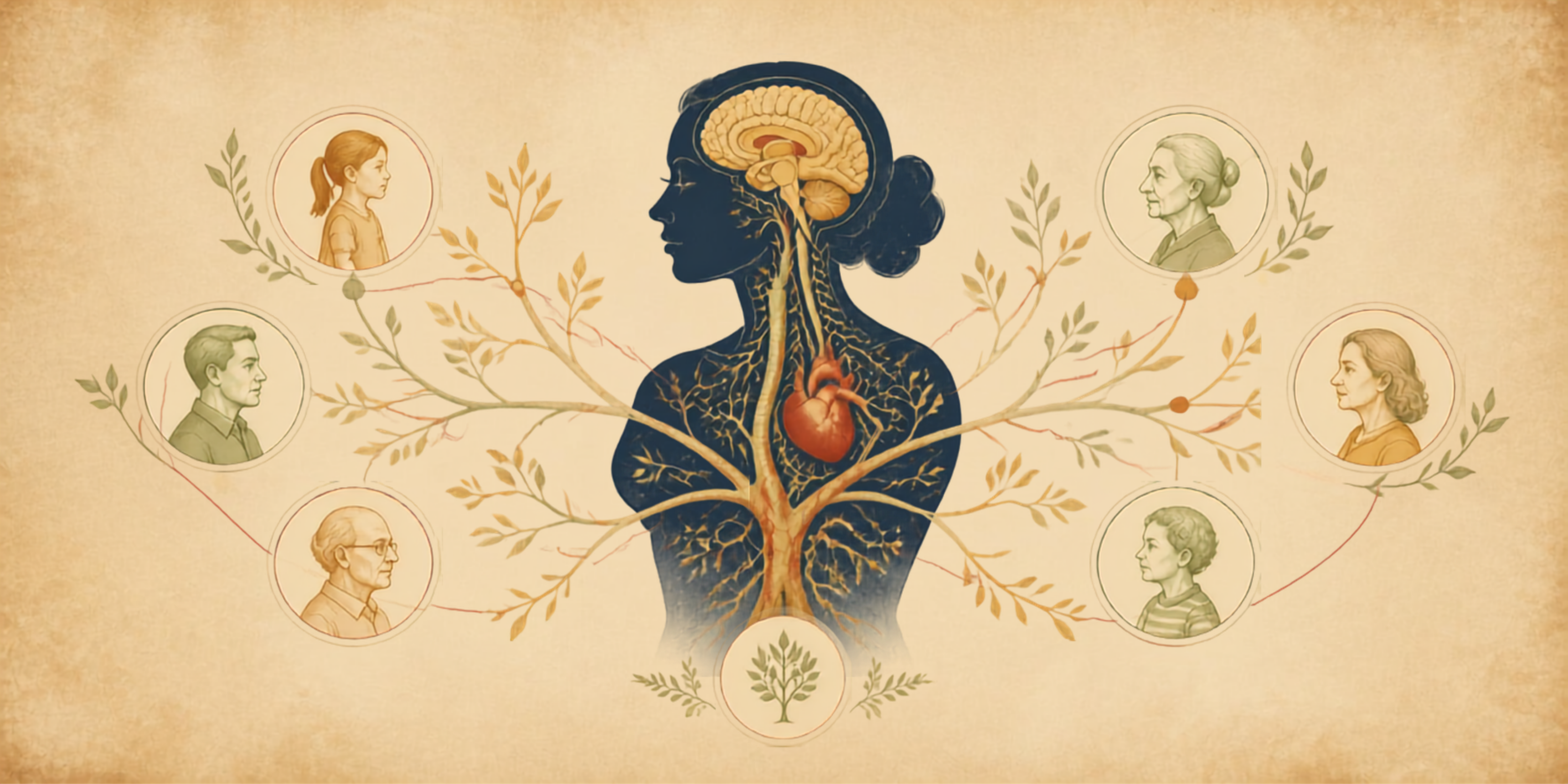
You may have heard of the sandwich generation. Where adults are "sandwiched" between raising children and caring for elderly parents. It is often framed as a market segment or demographic; however, for women, it is viewed as a workload.
In the United States, women perform 76.2% of unpaid care work, which is roughly 3.2 times what men do. Sixty-one percent of women say they retired earlier than they planned, often because of caregiving or their own health. AARP puts the pool of family caregivers in the US at over 63 million people, and about six in ten are women.
The woman in the middle is not fragile. She is doing the work of a hospital discharge planner, a special education advocate, a primary care coordinator, and a household CFO on top of the job that pays her. When her brain and body starts sending signals, she absorbs and buries them. The system was not built to catch her before she breaks.
Disability and women's health: same category, seen from two angles
Our thesis at Adaptation Ventures has always been that disability is the largest under-served market in the world. Women's health is the same category viewed from another angle. Four numbers make that clear:
- 708 million women worldwide live with a disability, according to the World Health Organization. That is a country twice the size of the United States.
- 80% of autoimmune disease patients are women, per the NIH. Autoimmune disease is the fifth-leading cause of death in women under 65.
- 81% of caregivers for people with disabilities are women, a pattern documented across the Alzheimer's Association, AARP, and ILO data.
- 1 in 10 women of reproductive age has endometriosis, per the World Health Organization. That is 190 million women, most undiagnosed for seven to ten years.
Every one of these is a disability story, a caregiving story, and a diagnostic story at the same time.
Conditions that fall harder on women
Roughly 80% of the conditions Adaptation looks at are invisible, which means they get funded last and misdiagnosed first. UBS Chief Investment Office's January 2026 report "Women and health," by Marianna Mamou, documents the following based on a 21-year Danish study of nearly 7 million people, compared to men, women are:
- Seven times more likely to have heart conditions misdiagnosed
- Wait five times longer for a heart failure diagnosis
- Wait 2.5 years longer for a cancer diagnosis and 4.5 years longer for a diabetes diagnosis
Biology certainly plays a role, but the pattern below happens when research budgets, clinical trials, and product design skip half the population. The table below dives even deeper into the prevalence of certain conditions and disabilities, broken down by those specific to females, more predominant in females, and compounded by their role as primary caregivers.
| Condition | Bucket | Prevalence in Women |
|---|---|---|
| Endometriosis | Female-specific | 10% of women of reproductive age (190M globally); diagnostic delay 7-10 years |
| Perinatal depression | Female-specific | 1 in 7 women during pregnancy or the year after childbirth; ~50% undiagnosed |
| Retinopathy of prematurity | Female-specific (pregnancy) | Leading cause of childhood blindness worldwide, tied to preterm birth and neonatal care |
| Autoimmune disease | Female-predominant | ~78–80% of patients are women; fifth-leading cause of death in women under 65 |
| Migraine | Female-predominant | 3 to 4 times more common in women; fourth-leading cause of disability in women |
| Thyroid disease | Female-predominant | Women are 5 to 8 times more likely to have thyroid disease |
| Osteoporosis | Female-predominant | Women 50 and older have 4x the rate of osteoporosis and 2x the rate of osteopenia versus men |
| Alzheimer's disease | Female-predominant | Nearly two-thirds of Americans with Alzheimer's are women; lifetime risk at 65 is 1 in 5 |
| Long COVID | Female-predominant | Women have a 31% higher risk of long COVID |
| Autism (family impact) | Female-compounded (caregiving) | Mothers provide the majority of daily support for autistic children in the US |
| Dementia (family impact) | Female-compounded (caregiving) | Women comprise 60-70% of unpaid Alzheimer's and dementia caregivers |
Read the table as three overlapping circles. Some conditions only happen to women. Some hit women disproportionately. Some hit the women who care for the people who have them. In practice, one household can contain all three.
The caregiver multiplier
When we invest in a company that helps a mother manage her autistic son's sleep, we are not funding one intervention. We are funding a compounding return. Better sleep for Matthew can contribute to improved behavioral outcomes during the day, which means Judith keeps her job, Judith and her husband are more well-rested, the household holds together, Judith's mother stays in their home instead of a facility, Medicaid saves money, and Judith's own health does not collapse into the next diagnosis. One product changes the trajectory of three lives at once.
This is the curb cut effect running through a family, not a sidewalk. Put a ramp through the curb, and the whole neighborhood moves, as we wrote in Issue 06 Curb Cut Effect. Similarly, build for the woman in the middle – and the whole household moves. Every dollar of clinical benefit she captures shows up again in her child, her parent, her employer, and her own next thirty years. That is the arithmetic of compound interest in health.
Independence, potential, dignity
Our mission is to maximize human independence, potential, and dignity. Through the lens above:
- Independence looks like a 44-year-old with endometriosis getting a real diagnostic path instead of another script for ibuprofen and another year of chronic abdominal pain, menstrual disorders, missed work, and decreased quality of life.
- Potential looks like an autistic 11-year-old whose mother has the tools to work and communicate with him rather than around him, so both of them get to maximize what they set their minds to.
- Dignity looks like a 71-year-old post-hip-replacement grandmother recovering in her own home with the right assistive product, not in a facility that bills her daughter thousands of dollars a month despite staff shortages from professional caregiver attrition.
These are three different companies, three different markets, and one thesis.
Founders already building here
The women's health lens is not theoretical for us. High-growth startups already reflect the impact.
- REA Diagnostics developed the first self-test for preterm birth risk, where preterm birth is the leading cause of death in children under five and the leading cause of childhood blindness.
- HapWare is building haptic assistive technology for people with sensory and mobility disabilities, a population where the majority of end users and the majority of family caregivers are women. HapWare is an Adaptation Ventures portfolio company.
- ReviMo is building robotic mobility technology that can help the millions of women navigating mobility loss or caring for a family member that requires lifting from a seated position. ReviMo is an Adaptation Ventures portfolio company.
- Accordia Surgical (formerly Fetal Therapy Technologies) is building surgical tools for in-utero interventions that address conditions that adult product lines don't solve, in a category where maternal mortality still kills more than 800 women a day globally.
None of these companies are pitched as "women's health" companies. They pitch as disability, diagnostics, robotic mobility and rehab, surgery, and sleep companies. The women's health story is what the market data looks like when you add up their end users.
$100B+ in exits
Women's health is no longer a category that needs to be defended. The exits speak for themselves. There have been $100 billion+ in exits over 25 years: 276 total exits, 27 above $1 billion, and $27 billion in exit value in 2025 alone. WHAM and the Autoimmune Research Collaborative also model that every $350 million invested in women's health research returns roughly $14 billion in economic value, a 40x multiple.
Venture funding into women's health has more than tripled between 2019 and 2024, according to the UBS "Women and health" report by Marianna Mamou (UBS Chief Investment Office, January 2026), while still representing only about 2.3% of healthcare in venture. That gap is the opportunity.
Mainstream capital sees it too. Pivotal Ventures, Melinda French Gates' firm, has committed $600 million to women's health over the next two years, including a $250 million Action for Women's Health open call and a $100 million partnership with Wellcome Leap. The Bill & Melinda Gates Foundation has pledged $2.5 billion to women's health R&D through 2030. The ARPA-H Sprint for Women's Health has moved federal dollars into the space at a pace the NIH historically has not.
Will the shift in wealth impact health?
The capital side of this market is also shifting under our feet. Women in the United States are projected to control roughly $34 trillion in investable assets by 2030, according to McKinsey's analysis of the great wealth transfer, and to inherit roughly 70% of the estimated $124 trillion moving between generations over the next two decades. The World Economic Forum has put women at 40% of global investable wealth by 2030. Family offices are moving in the same direction: Deloitte's Family Office Insights reports that women lead about 15% of family offices globally and 37% of family office CEO roles in the UK.
UBS's Chief Investment Office has published useful work on what this shift means for allocators. Their January 2026 "Women and health" report covers both the clinical gap and the investment case, and the UBS Global Wealth Management team, through its Head of Women's Wealth, has developed a broader research framework for how private wealth can approach the category. Institutional research of this kind helps a women's health thesis move from a specialty pitch to a mainstream diversification discussion.
When people think about disability tech, women's health is likely not what comes to mind. However, it is yet another example of how Adaptation's work crosses so many other areas, that its thesis is a curb cut in and of itself, and that the companies it funds are going to improve the health of many millions of women.
Closing
Women's health is where the largest underserved user base, the most compounded family impact, and the biggest exit proof all overlap. Our approach to disability hardware, the curb cut effect, and sensory healing/diagnostics intersect this space.
When innovation reaches the woman in the middle of a household, three generations move at once, and the return compounds across her child, her parent, her employer, and her own next thirty years. Our work is to keep making that math legible to the founders building here and to the capital that will define the next decade of health and care.
Thank you for being part of the Adaptation Ventures journey.
Best, The Adaptation Ventures Team
This journal is for informational purposes only, is not a prospectus, may not be relied on as legal, tax, securities or investment advice and does not constitute an offer to buy or sell interests in Adaptation Ventures Fund I (the "Fund").
Related essays / links shown on page:
- Issue 06: Curb Cut Effect — /insights/issue-06-curb-cut-effect
- Issue 08: Disability Hardware [Ethereal vs Material] — /insights/issue-08-ethereal-vs-material
- Issue 10: Root Access/Sensory Healing — /insights/issue-10-root-access